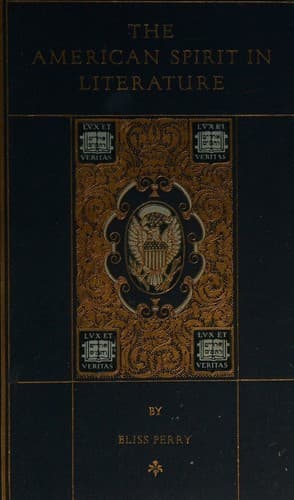
The American Spirit in Literature: A Chronicle of Great InterpretersPerry, Bliss
History
The American Spirit in Literature: A Chronicle of Great Interpreters
Perry, Bliss
American literature -- History and criticism
Foremost among the journalists of the great debate were William Lloyd
Garrison and Horace Greeley. Garrison was a perfect example of the
successful journalist as described by Zola--the man who keeps on
pounding at a single idea until he has driven it into the head of the
public. Everyone knows at least the sentence from his salutatory
editorial in The Liberator on January 1, 1831: "I am in earnest--I will
not retreat a single inch--And I will be heard." He kept this vow, and
he also kept the accompanying and highly characteristic promise: "I will
be as harsh as truth and as uncompromising as justice. On this subject,
I do not wish to think, or write, or speak, with moderation." But there
would be little political literature in the world if its production were
entrusted to the moderate type of man, and the files of The Liberator,
though certainly harsh and full of all uncharitableness towards
slave-owners, make excellent reading for the twentieth century American
who perceives that in spite of the triumph of emancipation, in which
Garrison had his fair share of glory, many aspects of our race-problem
remain unsolved. Horace Greeley, the founder and editor of the New York
Tribune, was a farmer's boy who learned early to speak and write the
vocabulary of the plain people. Always interested in new ideas, even in
Transcendentalism and Fourierism, his courage and energy and
journalistic vigor gave him leadership in the later phases of the
movement for enfranchisement. He did not hesitate to offer unasked
advice to Lincoln on many occasions, and Lincoln enriched our literature
by his replies. Greeley had his share of faults and fatuities, but in
his best days he had an impressively loyal following among both rural
and city-bred readers of his paper, and he remains one of the best
examples of that obsolescent personal journalism which is destined to
disappear under modern conditions of newspaper production. Readers
really used to care for "what Greeley said" and "Dana said" and "Sam
Bowles said," and all of these men, with scores of others, have left
their stamp upon the phrases and the tone of our political writing.
In the concrete issue of Slavery, however, it must be admitted that the
most remarkable literary victory was scored, not by any orator or
journalist, but by an almost unknown little woman, the author of Uncle
Tom's Cabin. No American novel has had so curious a history and so great
or so immediate an influence in this country and in Europe. In spite of
all that has been written about it, its author's purpose is still widely
misunderstood, particularly in the South, and the controversy over this
one epoch-making novel has tended to obscure the literary reputation
which Mrs. Stowe won by her other books.
Public-domain text, read in full here on John Shaqi.
Reviews
Reviews
No reviews yet
Be the first to share your thoughts on this work.
Elsewhere in the archive
Join the Discussion
Join the discussion
Sign in to leave a comment or review.
Sign InorCreate an account