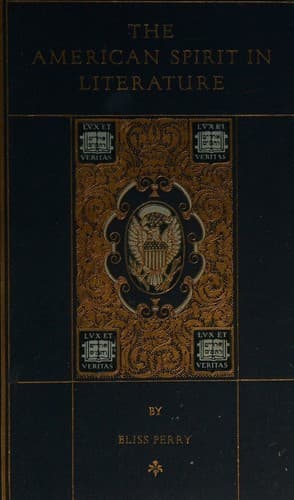
The American Spirit in Literature: A Chronicle of Great InterpretersPerry, Bliss
History
The American Spirit in Literature: A Chronicle of Great Interpreters
Perry, Bliss
American literature -- History and criticism
More and more, however, the instinct of our people is turning to the
words of Abraham Lincoln as the truest embodiment in language, as his
life was the truest embodiment in action, of our national ideal. It is a
curious reversal of contemporary judgments that thus discovers in the
homely phrases of a frontier lawyer the most perfect literary expression
of the deeper spirit of his time. "How knoweth this man letters, having
never learned?" asked the critical East. The answer is that he had
learned in a better school than the East afforded. The story of
Lincoln's life is happily too familiar to need retelling here, but some
of the elements in his growth in the mastery of speech may at least be
summarized.
Lincoln had a slow, tireless mind, capable of intense concentration. It
was characteristic of him that he rarely took notes when trying a law
case, saying that the notes distracted his attention. When his partner
Herndon was asked when Lincoln had found time to study out the
constitutional history of the United States, Herndon expressed the
opinion that it was when Lincoln was lying on his back on the office
sofa, apparently watching the flies upon the ceiling. This combination
of bodily repose with intense mental and spiritual activity is familiar
to those who have studied the biography of some of the great mystics.
Walter Pater pointed it out in the case of Wordsworth.
In recalling the poverty and restriction of Lincoln's boyhood and his
infrequent contact with schoolhouses, it is well to remember that he
managed nevertheless to read every book within twenty miles of him.
These were not many, it is true, but they included The Bible, Æesop's
Fables, Pilgrim's Progress, Robinson Crusoe, and, a little later, Burns
and Shakespeare. Better food than this for the mind of a boy has never
been found. Then he came to the history of his own country since the
Declaration of Independence and mastered it. "I am tolerably well
acquainted with the history of the country," he remarked in his Chicago
speech of 1858; and in the Cooper Union speech of 1860 he exhibited a
familiarity with the theory and history of the Constitution which amazed
the young lawyers who prepared an annotated edition of the address. "He
has wit, facts, dates," said Douglas, in extenuation of his own
disinclination to enter upon the famous joint debates, and, when Douglas
returned to Washington after the debates were over, he confessed to the
young Henry Watterson that "he is the greatest debater I have ever met,
either here or anywhere else." Douglas had won the senatorship and could
afford to be generous, but he knew well enough that his opponent's facts
and dates had been unanswerable. Lincoln's mental grip, indeed, was the
grip of a born wrestler. "I've got him," he had exclaimed toward the end
of the first debate, and the Protean Little Giant, as Douglas was
called, had turned and twisted in vain, caught by "that long-armed
Public-domain text, read in full here on John Shaqi.
Reviews
Reviews
No reviews yet
Be the first to share your thoughts on this work.
Elsewhere in the archive
Join the Discussion
Join the discussion
Sign in to leave a comment or review.
Sign InorCreate an account