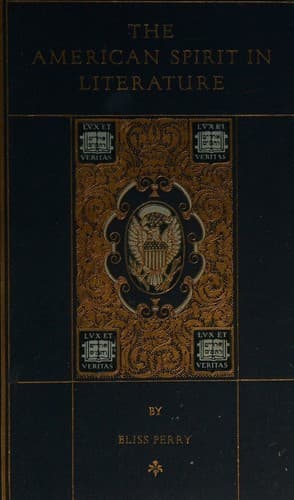
The American Spirit in Literature: A Chronicle of Great InterpretersPerry, Bliss
History
The American Spirit in Literature: A Chronicle of Great Interpreters
Perry, Bliss
American literature -- History and criticism
As the audience increased, the style took on beauty and breadth, as if
the man's soul were looking through wider and wider windows at the
world. But it always remained the simplest of styles. In an offhand
reply to a serenade by an Indiana regiment, or in answering a visiting
deputation of clergymen at the White House, Lincoln could summarize and
clarify a complicated national situation with an ease and orderliness
and fascination that are the despair of professional historians. He
never wasted a word. "Go to work is the only cure for your case," he
wrote to John D. Johnston. There are ten words in that sentence and none
of over four letters. The Gettysburg Address contains but two hundred
and seventy words, in ten sentences. "It is a flat failure," said
Lincoln despondently; but Edward Everett, who had delivered "the"
oration of that day, wrote to the President: "I should be glad if I
could flatter myself that I came as near to the central idea of the
occasion in two hours as you did in two minutes." Today the Address
reads as if Lincoln knew that it would ultimately be stamped in bronze.
Yet the real test of Lincoln's supremacy in our distinctly civic
literature lies not so much in his skill in the manipulation of
language, consummate as that was, but rather in those large elements of
his nature which enabled him to perceive the true quality and ideal of
American citizenship and its significance to the world. There was
melancholy in that nature, else there had been a less rich humor; there
was mysticism and a sense of religion which steadily deepened as his
responsibilities increased. There was friendliness, magnanimity, pity
for the sorrowful, patience for the slow of brain and heart, and an
expectation for the future of humanity which may best be described in
the old phrase "waiting for the Kingdom of God." His recurrent dream of
the ship coming into port under full sail, which preluded many important
events in his own life--he had it the night before he was
assassinated--is significant not only of that triumph of a free nation
which he helped to make possible, but also of the victory of what he
loved to call "the whole family of man." "That is the real issue," he
had declared in closing the debates with Douglas; "that is the issue
that will continue in this country when these poor tongues of Judge
Douglas and myself shall be silent. It is the eternal struggle between
these two principles--right and wrong--throughout the world. They are
the two principles that have stood face to face from the beginning of
time; and will ever continue to struggle. The one is the common right of
humanity, and the other the divine right of kings."
Public-domain text, read in full here on John Shaqi.
Reviews
Reviews
No reviews yet
Be the first to share your thoughts on this work.
Elsewhere in the archive
Join the Discussion
Join the discussion
Sign in to leave a comment or review.
Sign InorCreate an account