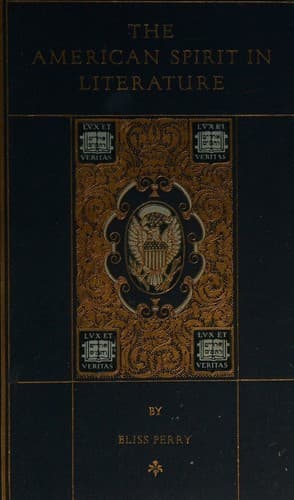
The American Spirit in Literature: A Chronicle of Great InterpretersPerry, Bliss
History
The American Spirit in Literature: A Chronicle of Great Interpreters
Perry, Bliss
American literature -- History and criticism
But the impulse spread far beyond the South. Early in the seventies
Edward Eggleston wrote The Hoosier Schoolmaster and The Circuit Rider,
faithful and moving presentations of genuine pioneer types which were
destined to pass with the frontier settlements. Soon James Whitcomb
Riley was to sing of the next generation of Hoosiers, who frequented The
Old Swimmin' Hole and rejoiced When the Frost is on the Punkin. It was
the era of Denman Thompson's plays, Joshua Whitcomb and The Old
Homestead. Both the homely and the exotic marched under this banner of
local color: Hamlin Garland presented Iowa barnyards and cornfields,
Helen Hunt Jackson dreamed the romance of the Mission Indian in Ramona,
and Lafcadio Hearn, Irish and Greek by blood, resident of New Orleans
and not yet an adopted citizen of Japan, tantalized American readers
with his Chinese Ghosts and Chita. A fascinating period it seems, as one
looks back upon it, and it lasted until about the end of the century,
when the suddenly discovered commercial value of the historical novel
and the ensuing competition in best sellers misled many a fine artistic
talent and coarsened the public taste. The New South then played the
literary market as recklessly as the New West.
Let us glance back to "the abandoned farm of literature," as a witty New
Yorker once characterized New England. The last quarter of the
nineteenth century witnessed a decline in the direct influence of that
province over the country as a whole. Its strength sapped by the
emigration of its more vigorous sons, its typical institutions sagging
under the weight of immense immigrations from Europe, its political
importance growing more and more negligible, that ancient promontory of
ideas has continued to lose its relative literary significance. In one
field of literature only has New England maintained its rank since the
Civil War, and that is in the local short story. Here women have
distinguished themselves beyond the proved capacity of New England men.
Mrs. Stowe and Rose Terry Cooke, women of democratic humor, were the
pioneers; then came Harriet Prescott Spofford and Elizabeth Stuart
Phelps, women with nerves; and finally the three artists who have
written, out of the material offered by a decadent New England, as
perfect short stories as France or Russia can produce--Sarah Orne
Jewett, Mary Wilkins Freeman, and Alice Brown. These gifted writers
portrayed, with varying technique and with singular differences in their
instinctive choice of material, the dominant qualities of an isolated,
in-bred race, still proud in its decline; still inquisitive and
acquisitive, versatile yet stubborn, with thrift passing over into
avarice, and mental power degenerating into smartness; cold and hard
under long repression of emotion, yet capable of passion and fanaticism;
at worst, a mere trader, a crank, a grim recluse; at best, endowed with
an austere physical and moral beauty. Miss Jewett preferred to touch
Public-domain text, read in full here on John Shaqi.
Reviews
Reviews
No reviews yet
Be the first to share your thoughts on this work.
Elsewhere in the archive
Join the Discussion
Join the discussion
Sign in to leave a comment or review.
Sign InorCreate an account