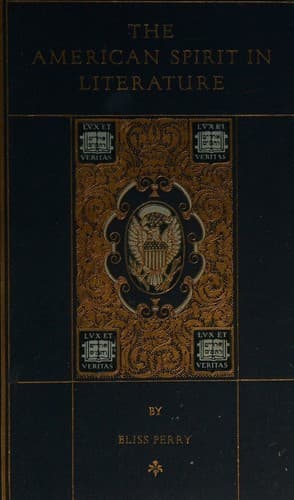
The American Spirit in Literature: A Chronicle of Great InterpretersPerry, Bliss
History
The American Spirit in Literature: A Chronicle of Great Interpreters
Perry, Bliss
American literature -- History and criticism
A picture of the Knickerbocker era is not complete without its portraits
of the minor figures in the literary life of New York up to the time of
the Civil War. But the scope of the present volume does not permit
sketches of Paulding and Verplanck, of Halleck and his friend Drake, of
N. P. Willis and Morris and Woodworth. Some of these are today only
"single-poem" men, like Payne, the author of Home Sweet Home, just as
Key, the author of The Star-Spangled Banner, is today a "single-poem"
man of an earlier generation. Their names will be found in such limbos
of the dead as Griswold's Poets and Poetry of America and Poe's
Literati. They knew "the town" in their day, and pleased its very easily
pleased taste. The short-lived literary magazines of the
eighteen-forties gave them their hour of glory. As representatives of
passing phases of the literary history of New York their careers are not
without sentimental interest, but few of them spoke to or for the
country as a whole. Two figures, indeed, stand out in sharp contrast
with those habitual strollers on Broadway and frequenters of literary
gatherings, though each of them was for a while a part of Knickerbocker
New York. To all appearances they were only two more Bohemians like the
rest, but the curiosity of the twentieth century sets them apart from
their forgotten contemporaries. They are two of the unluckiest--and yet
luckiest--authors who ever tried to sell a manuscript along Broadway.
One of them is Edgar Allan Poe and the other is Walt Whitman. They shall
have a chapter to themselves.
But before turning to that chapter, we must look back to New England
once more and observe the blossoming-time of its ancient commonwealths.
During the thirty years preceding the Civil War New England awoke to a
new life of the spirit. So varied and rich was her literary
productiveness in this era that it still remains her greatest period,
and so completely did New England writers of this epoch voice the ideals
of the nation that the great majority of Americans, even today, regard
these New Englanders as the truest literary exponents of the mind and
soul of the United States. We must take a look at them.
CHAPTER VI.
The Transcendentalists
Public-domain text, read in full here on John Shaqi.
Reviews
Reviews
No reviews yet
Be the first to share your thoughts on this work.
Elsewhere in the archive
Join the Discussion
Join the discussion
Sign in to leave a comment or review.
Sign InorCreate an account