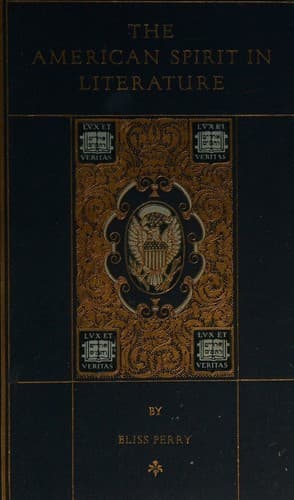
The American Spirit in Literature: A Chronicle of Great InterpretersPerry, Bliss
History
The American Spirit in Literature: A Chronicle of Great Interpreters
Perry, Bliss
American literature -- History and criticism
Once, toward the close of his too brief life, Thoreau "signed on" again
to an American ideal, and no man could have signed more nobly. It was
the cause of Freedom, as represented by John Brown of Harper's Ferry.
The French and Scotch blood in the furtive hermit suddenly grew hot.
Instead of renouncing in disgust the "uncivil chaos called Civil
Government," Thoreau challenged it to a fight. Indeed he had already
thrown down the gauntlet in Slavery in Massachusetts, which Garrison had
published in the Liberator in 1854. And now the death upon the scaffold
of the old fanatic of Ossawatomie changed Thoreau into a complete
citizen, arguing the case and glorifying to his neighbors the dead hero.
"It seems as if no man had ever died in America before; for in order to
die you must first have lived.... I hear a good many pretend that they
are going to die.... Nonsense! I'll defy them to do it. They haven't got
life enough in them. They'll deliquesce like fungi, and keep a hundred
eulogists mopping the spot where they left off. Only half a dozen or so
have died since the world began." Such passages as this reveal a very
different Thoreau from the Thoreau who is supposed to have spent his
days in the company of swamp-blackbirds and woodchucks. He had, in fact,
one of the highest qualifications for human society, an absolute honesty
of mind. "We select granite," he says, "for the underpinning of our
houses and barns; we build fences of stone; but we do not ourselves rest
on an underpinning of granite truth, the lowest primitive rock. Our
sills are rotten.... In proportion as our inward life fails, we go more
constantly and desperately to the post-office. You may depend upon it,
that the poor fellow who walks away with the greatest number of letters,
proud of his extensive correspondence, has not heard from himself this
long time."
This hard, basic individualism was for Thoreau the foundation of all
enduring social relations, and the dullest observer of twentieth century
America can see that Thoreau's doctrine is needed as much as ever. His
sharp-edged personality provokes curiosity and pricks the reader into
dissent or emulation as the case may be, but its chief ethical value to
our generation lies in the fact that here was a Transcendentalist who
stressed, not the life of the senses, though he was well aware of their
seductiveness, but the stubborn energy of the will.
Public-domain text, read in full here on John Shaqi.
Reviews
Reviews
No reviews yet
Be the first to share your thoughts on this work.
Elsewhere in the archive
Join the Discussion
Join the discussion
Sign in to leave a comment or review.
Sign InorCreate an account