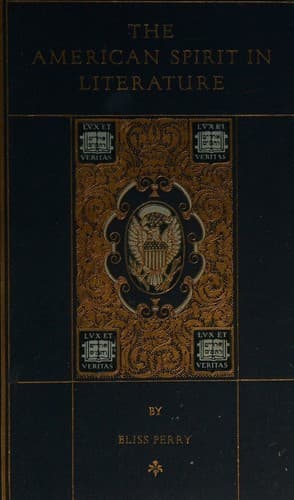
The American Spirit in Literature: A Chronicle of Great InterpretersPerry, Bliss
History
The American Spirit in Literature: A Chronicle of Great Interpreters
Perry, Bliss
American literature -- History and criticism
In the eighteen years from 1831 to 1849, when Poe's unhappy life came to
an end in a Baltimore hospital, his literary activity was chiefly that
of a journalist, critic, and short story writer. He lived in Baltimore,
Richmond, Philadelphia, and New York. Authors who now exploit their fat
bargains with their publishers may have forgotten that letter which Poe
wrote back to Philadelphia the morning after he arrived with his
child-wife in New York: "We are both in excellent spirits.... We have
now got four dollars and a half left. To-morrow I am going to try and
borrow three dollars, so that I may have a fortnight to go upon." When
the child-wife died in the shabby cottage at Fordham, her wasted body
was covered with the old army overcoat which Poe had brought from West
Point. If Poe met some of the tests of practical life inadequately, it
must be remembered that his health failed at twenty-five, that he was
pitiably poor, and that the slightest indulgence in drink set his
over-wrought nerves jangling. Ferguson, the former office-boy of the
"Literary Messenger," judged this man of letters with an office-boy's
firm and experienced eye: "Mr. Poe was a fine gentleman when he was
sober. He was ever kind and courtly, and at such times everyone liked
him. But when he was drinking he was about one of the most disagreeable
men I have ever met." "I am sorry for him," wrote C. F. Briggs to
Lowell. "He has some good points, but taken altogether, he is badly made
up." "Badly made up," no doubt, both in body and mind, but all
respectable and prosperous Pharisees should be reminded that Poe did not
make himself; or rather, that he could not make himself over. Very few
men can. Given Poe's temperament, and the problem is insoluble. He wrote
to Lowell in 1844: "I have been too deeply conscious of the mutability
and evanescence of temporal things to give any continuous effort to
anything--to be consistent in anything. My life has been
whim--impulse--passion--a longing for solitude--a scorn of all things
present in an earnest desire for the future." It is the pathetic
confession of a dreamer. Yet this dreamer was also a keen analyzer, a
tireless creator of beautiful things. In them he sought and found a
refuge from actuality. The marvel of his career is, as I have said
elsewhere, that this solitary, embittered craftsman, out of such
hopeless material as negations and abstractions, shadows and
superstitions, out of disordered fancies and dreams of physical horror
and strange crime, should have wrought structures of imperishable
beauty.
Public-domain text, read in full here on John Shaqi.
Reviews
Reviews
No reviews yet
Be the first to share your thoughts on this work.
Elsewhere in the archive
Join the Discussion
Join the discussion
Sign in to leave a comment or review.
Sign InorCreate an account