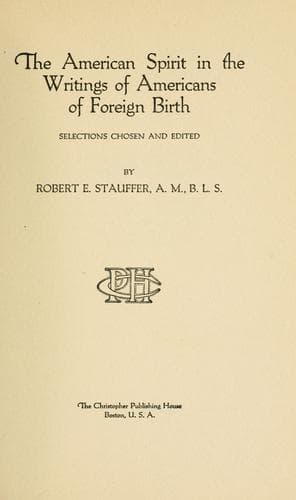
The American Spirit in the Writings of Americans of Foreign Birth
General
The American Spirit in the Writings of Americans of Foreign Birth
American literature; Americanization; Noncitizens -- United States
Our belief in children, like our belief in many other good things, is
mainly a word belief. What we need is a practical belief. We are still
at the stage where we separate work and thought, action and theory,
practice and ethics. If we would be saved, we must follow the child’s
way of life. His way is the direct way. He learns from contact with the
forces about him. He feels them, he sees them, he knows what they do
to him. He thinks and does and discovers all in one continuous flow of
energy.
The child says: “I am of things as they are. I am the fighter for the
things that ought to be. I was the beginning of human progress, and
I am the progress of the world. I drive the world on. I invent, I
achieve, I reform. About me is always the glory of mounting. I have no
fear of falling, of slipping down, down. I have no fear of being lost.
I am truth. I am reality, and always I question chaos.”
When the child begins to question the wisdom of the group, its
religion, its literature, its dress, its tastes, its method of
government, its standard of judgment, that moment the group should
begin to take heed. It should take the child’s questioning seriously.
When the group fails to do this, it gives up its existence, it ceases
to grow because it looks back, it worships tradition, it makes history
in terms of the past rather than in terms of the future.
Belief in evolution is a belief in the child.
What the race needs is a principle of growth, spiritual growth, that
can never be denied. Such a principle it will find in the child,
because the spirit of the child is the one factor of the group
existence that in itself keeps changing, growing. The child is nature’s
newest experiment in her search for a better type, and the race will be
strong as it determines that the experiment shall be successful.
We develop national characteristics in accord with our adherence to
a common ideal. We must therefore surrender ourselves for the common
good, and the common good to which we should surrender is epitomized in
the child idea.
I feel that the attitude towards the school and the child is the
ultimate attitude by which America is to be judged. Indeed, the
distinctive contribution America is to make to the world’s progress is
not political, economical, religious, but educational, the child our
national strength, the school as the medium through which the adult is
to be remade.
What an ideal for the American people!
When my father came to America, he thought of America only as a
temporary home. He learned little or no English. As the years went
by he would say, “It is enough; my children know English.” Then more
years rolled by. One day he came to me and asked me to help him get
his citizenship papers. He and I began reading history together. Month
after month we worked, laboring, translating, questioning, until the
very day of his examination.
That day I hurried home from college to find a smiling, happy father.
“Did you get them?” I asked.
Public-domain text, read in full here on John Shaqi.
Reviews
Reviews
No reviews yet
Be the first to share your thoughts on this work.
Elsewhere in the archive
Join the Discussion
Join the discussion
Sign in to leave a comment or review.
Sign InorCreate an account