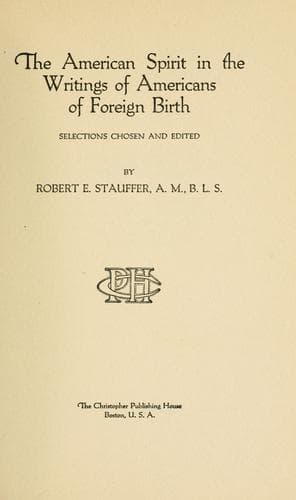
The American Spirit in the Writings of Americans of Foreign Birth
General
The American Spirit in the Writings of Americans of Foreign Birth
American literature; Americanization; Noncitizens -- United States
The hunger of my heart drove me to the night-school. Again my dream
flamed. Again America beckoned. In the school there would be education,
air, life for my cramped-in spirit. I would learn to think, to form
the thoughts that surged formless in me. I would find the teacher that
would make me articulate.
I joined the literature class. They were reading “The De Coverley
Papers.” Filled with insatiate thirst, I drank in every line with
the feeling that any moment I would get to the fountain-heart of
revelation. Night after night I read with tireless devotion. But of
what? The manners and customs of the eighteenth century, of people two
hundred years dead.
One evening, after a month’s attendance, when the class had dwindled
from fifty to four, and the teacher began scolding us who were present
for those who were absent, my bitterness broke.
“Do you know why all the girls are dropping away from the class? It’s
because they have too much sense than to waste themselves on ‘The De
Coverley Papers.’ Us four girls are four fools. We could learn more
in the streets. It’s dirty and wrong, but it’s life. What are ‘The De
Coverley Papers?’ Dry dust fit for the ash-can.”
“Perhaps you had better tell the principal your ideas of the standard
classics,” she scoffed, white with rage.
“All right,” I snapped, and hurried down to the principal’s office.
I swung open the door.
“I just want to tell you why I’m leaving. I--”
“Won’t you come in?” The principal rose and placed a chair for me
near her desk. “Now tell me all.” She leaned forward with an inviting
interest.
I looked up, and met the steady gaze of eyes shining with light. In
a moment all my anger fled. “The De Coverley Papers” were forgotten.
The warm friendliness of her face held me like a familiar dream. I
couldn’t speak. It was as if the sky suddenly opened in my heart.
“Do go on,” she said, and gave me a quick nod. “I want to hear.”
The repression of centuries rushed out of my heart. I told her
everything--of the mud hut in Sukovoly where I was born, of the Czar’s
pogroms, of the constant fear of the Cossack, of Gedalyah Mindel’s
letter, of our hopes in coming to America, and my search for an
American who would make America real.
“I am so glad you came to me,” she said. And after a pause, “You can
help me.”
“Help you?” I cried. It was the first time that an American suggested
that I could help her.
“Yes, indeed. I have always wanted to know more of that mysterious,
vibrant life--the immigrant. You can help me know my girls. You have so
much to give--”
“Give--that’s what I was hungering and thirsting all these years--to
give out what’s in me. I was dying in the unused riches of my soul.”
“I know; I know just what you mean,” she said, putting her hand on mine.
My whole being seemed to change in the warmth of her comprehension. “I
have a friend,” it sang itself in me. “I have a friend!”
Public-domain text, read in full here on John Shaqi.
Reviews
Reviews
No reviews yet
Be the first to share your thoughts on this work.
Elsewhere in the archive
Join the Discussion
Join the discussion
Sign in to leave a comment or review.
Sign InorCreate an account