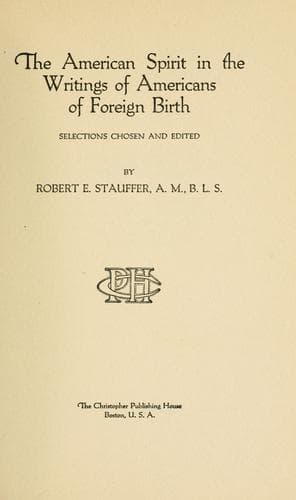
The American Spirit in the Writings of Americans of Foreign Birth
General
The American Spirit in the Writings of Americans of Foreign Birth
American literature; Americanization; Noncitizens -- United States
It is this insistence on the philosophic sanction of our revolt that
gives the sublime touch to our political performance. Up to the moment
of our declaration of independence, our struggle with our English
rulers did not differ from other popular struggles against despotic
governments. Again and again we respectfully petitioned for redress
of specific grievances, as the governed, from time immemorial, have
petitioned their governors. But one day we abandoned our suit for
petty damages, and instituted a suit for the recovery of our entire
human heritage of freedom; and by basing our claim on the fundamental
principles of the brotherhood of man and the sovereignty of the masses,
we assumed the championship of the oppressed against their oppressors,
wherever found.
It was thus, by sinking our particular quarrel with George of England
in the universal quarrel of humanity with injustice, that we emerged a
distinct nation, with a unique mission in the world. And we revealed
ourselves to the world in the Declaration of Independence, even as
the Israelites revealed themselves in the Law of Moses. From the
Declaration flows our race consciousness, our sense of what is and
what is not American. Our laws, our policies, the successive steps of
our progress,--all must conform to the spirit of the Declaration of
Independence, the source of our national being.
The American confession of faith, therefore, is a recital of the
doctrines of liberty and equality. A faithful American is one who
understands these doctrines and applies them in his life.
ABRAHAM MITRIE RIHBANY
An intense seriousness is one of the prominent characteristics of the
writings of the immigrant; for immigration is a serious and often
a hazardous undertaking, as the immigrant best knows. But that he
has not failed to appreciate the amusing side of the readjustment
period is evidenced by the many touches of humor in his accounts
of his relation to his new environment. One of the most pleasing
and inspiriting of these accounts is “A Far Journey,” by Abraham M.
Rihbany, who was born in Syria in the year 1869, and who came to the
United States with little money, but with much native intelligence
and an open and receptive mind and soul, eager for the very best that
America has to give.
Public-domain text, read in full here on John Shaqi.
Reviews
Reviews
No reviews yet
Be the first to share your thoughts on this work.
Elsewhere in the archive
Join the Discussion
Join the discussion
Sign in to leave a comment or review.
Sign InorCreate an account