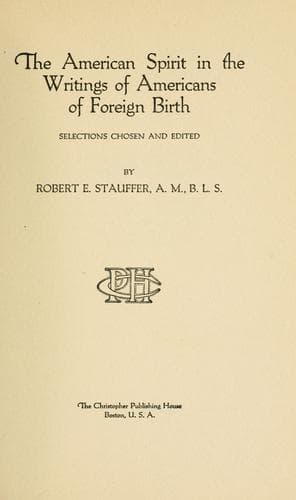
The American Spirit in the Writings of Americans of Foreign Birth
General
The American Spirit in the Writings of Americans of Foreign Birth
American literature; Americanization; Noncitizens -- United States
So it came to pass that we did not know what _my country_ could mean
to a man. And as we had no country, so we had no flag to love. It was
by no far-fetched symbolism that the banner of the House of Romanoff
became the emblem of our latter-day bondage in our eyes. Even a child
would know how to hate the flag that we were forced, on pain of severe
penalties, to hoist above our housetops, in celebration of the advent
of one of our oppressors. And as it was with country and flag, so it
was with heroes of war. We hated the uniform of the soldier, to the
last brass button. On the person of a Gentile, it was the symbol of
tyranny; on the person of a Jew, it was the emblem of shame.
So a little Jewish girl in Polotzk was apt to grow up hungry-minded
and empty-hearted; and if, still in her outreaching youth, she was set
down in a land of outspoken patriotism, she was likely to love her
new country with a great love, and to embrace its heroes in a great
worship. Naturalization, with us Russian Jews, may mean more than the
adoption of the immigrant by America. It may mean the adoption of
America by the immigrant.
THE LAW OF THE FATHERS: A VIEW OF THE DECLARATION OF INDEPENDENCE
If I ask an American what is the fundamental American law, and he does
not answer me promptly, “That which is contained in the Declaration of
Independence,” I put him down for a poor citizen. He who is ignorant
of the law is likely to disobey it. And there cannot be two minds
about the position of the Declaration among our documents of State.
What the Mosaic Law is to the Jews, the Declaration is to the American
people. It affords us a starting-point in history and defines our
mission among the nations. Without it, we should not differ greatly
from other nations who achieved a constitutional form of government and
various democratic institutions. What marks us out from other advanced
nations is the origin of our liberties in one supreme act of political
innovation, prompted by a conscious sense of the dignity of manhood. In
other countries advances have been made by favor of hereditary rulers
and aristocratic parliaments, each successive reform being grudgingly
handed down to the people from above. Not so in America. At one bold
stroke we shattered the monarchical tradition, and installed the people
in the seats of government, substituting the gospel of the sovereignty
of the masses for the superstition of the divine right of kings.
And even more notable than the boldness of the act was the dignity
with which it was entered upon. In terms befitting a philosophical
discourse, we gave notice to the world that what we were about to do,
we would do in the name of humanity, in the conviction that as justice
is the end of government, so should manhood be its source.
Public-domain text, read in full here on John Shaqi.
Reviews
Reviews
No reviews yet
Be the first to share your thoughts on this work.
Elsewhere in the archive
Join the Discussion
Join the discussion
Sign in to leave a comment or review.
Sign InorCreate an account