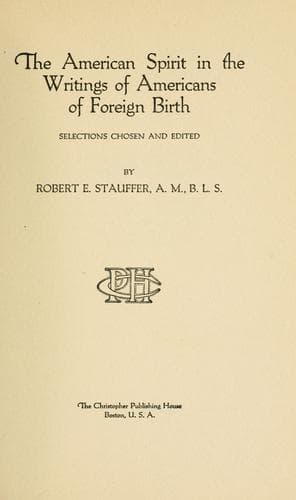
The American Spirit in the Writings of Americans of Foreign Birth
General
The American Spirit in the Writings of Americans of Foreign Birth
American literature; Americanization; Noncitizens -- United States
Some day the sense of injustice suffered may come to them, and they
will ask themselves whether every man in Kansas who drinks beer is
punished as they were. They will wonder why real criminals go free, or
escape with nominal punishment. I venture to predict that in some great
crisis, when this country needs men who respect her laws and love her
institutions, these men, and multitudes of others who have suffered
such injustices as they have, will fail her.
I pleaded for those imprisoned Greeks that night, and my plea was
effective. The just judge who condemned them pardoned them; but so just
was he that the fine of one hundred dollars each, not yet paid, was
left hanging over them, and to their credit be it said, they remained
in that town and paid every cent of it. This judge no doubt knows
his New Testament; he certainly made the Greeks pay the “uttermost
farthing” before his outraged sense of justice was appeased.
Those Greeks spent, together, over three years in jail, forfeited more
than fifteen hundred dollars in wages, and lost in bodily health and
self-respect beyond calculation.
Another incident occurred last spring as I was passing through a border
on one of those nerve-racking coal roads.
At a small, desolate mining village a group of men entered the car,
unwillingly enough. They were chained to one another and were driven
to their seats with curses and the butt of a gun. They were Italian
miners, part of that human material now scattered all over the United
States, carried by something swifter, though not less insistent than
the glacial movements which graved the beds of the rivers and shifted
so much of earth’s original scenery. There was some danger of violence,
and the accompanying minions of the law held back the angry passengers.
There was scarcely a moment, however, when they themselves did not
apply some vigorous measure to assure themselves that three undersized
Southern Italians, chained to one another, should not escape them.
The car was uncomfortably crowded and grew more so at every station;
for the next day the new governor was to be inaugurated at the capital,
toward which our train was leisurely travelling.
I had some difficulty in ethnologically classifying the man who shared
my seat. He was large, the colonel and major type, although his head
was rounder. The features, too, were of a different cast, his speech
less refined and his manners less gentle.
He wore a broad, new hat, his hair was long, curling slightly, and he
had an air of special importance, the cause of which I discovered later.
“I wonder why they are treating those poor fellows so roughly,” I
audibly soliloquized, turning to him. He was studying a typewritten
document and evidently did not relish the interruption.
“Is that any of your business?” he asked, punctuating the short
sentence with a liberal supply of oaths.
Public-domain text, read in full here on John Shaqi.
Reviews
Reviews
No reviews yet
Be the first to share your thoughts on this work.
Elsewhere in the archive
Join the Discussion
Join the discussion
Sign in to leave a comment or review.
Sign InorCreate an account