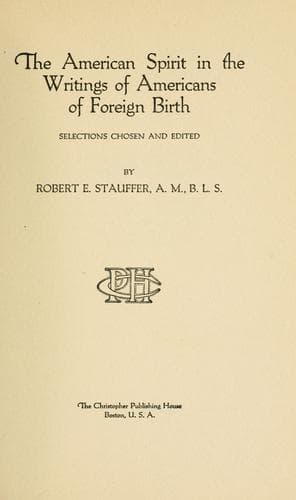
The American Spirit in the Writings of Americans of Foreign Birth
General
The American Spirit in the Writings of Americans of Foreign Birth
American literature; Americanization; Noncitizens -- United States
What has kept me from becoming an Anarchist, from being jailed or
hanged for leading mobs against their despoilers, God alone knows. His
guidance is as unquestioned as it is mysterious. There were disclosed
to me, early in my career, in some strange way, the spiritual values
latent here. In spite of the gross, granite-like materialism at the
top, I discovered the richness of the heritage left by the fathers of
this Republic; in spite of the poverty and hardship in which I had
to share, I saw here the fine quality of its vision; in spite of the
crudeness of its blundering ways, all the love a man may have for a
country grew in my heart, and changed only in growing stronger. Yet I
am not in the mood to call to account those toilers whose patriotism is
less fervent than mine and whose ideals are still held in check by the
“stomach line.”
Editors and preachers, teachers and capitalists, with all the loud if
not mighty host of us who are yammering about the want of patriotism
among the masses, and the weakness of our national spirit; we are the
first who must move a notch higher in our love of country and above the
“stomach line.” We must make real the spiritual ideals for which this
country stands, or at least try to realize them, before we can teach
the alien and his children, or even our own, the meaning of liberty and
democracy. Before we can ask them to die for our country we shall have
to learn to live for it, and the definite task we have before us is not
the mere idolatry of our flag, or the making of shard and shell.
To provide an adequate wage for our men, to so arrange our industrial
order that there shall not be feverish activity to-day, and idleness,
poverty, bread lines and soup kitchens to-morrow. To make working
conditions tolerable, to provide against accidents and sickness,
unemployment and old age, and to be true to the life about us.
These are national factors, essential to the making of an effective
national state in our industrial age. Capital, in common with labor,
must learn how to lend itself to the national purpose; for we have come
upon a time, or the time has come upon us, when we must learn how to
melt all classes, all sections and all races into a final unit. This
is the time to touch the hearts and gain the confidence of all the
people by a high regard for all, so that together we may turn our faces
towards our ultimate goal....
The Commonwealth Steel Company of Granite City, Illinois, one of those
remarkable corporations with a soul, whose business is rooted in the
ideal of service, found its foreign laborers quartered in what was
called “Hungry Hollow.” This company so exemplified the American spirit
of fair play that, when the foreign employees were aroused to proper
civic pride, they rebaptized “Hungry Hollow” into “Lincoln Place,”
because Lincoln’s spirit was manifested towards them.
Public-domain text, read in full here on John Shaqi.
Reviews
Reviews
No reviews yet
Be the first to share your thoughts on this work.
Elsewhere in the archive
Join the Discussion
Join the discussion
Sign in to leave a comment or review.
Sign InorCreate an account