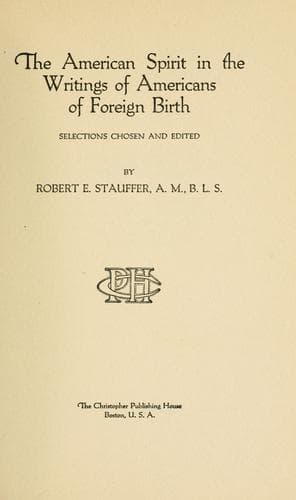
The American Spirit in the Writings of Americans of Foreign Birth
General
The American Spirit in the Writings of Americans of Foreign Birth
American literature; Americanization; Noncitizens -- United States
We have often heard it said recently--it has become rather the fashion
to say it--that the rulership of the world will henceforth belong to
labor. I yield to no one in my respect and sympathy for labor, or in my
cordial and sincere support of its just claims. The structure of our
institutions cannot stand unless the masses of workmen, farmers, indeed
all large strata of society, feel that under and by these institutions
they are being given a square deal within the limits, not of Utopia,
but of what is sane, right and practicable.
But the rulership of the world will and ought to belong to no one
class. It will and ought to belong neither to labor nor to capital,
nor to any other class. It will, of right and in fact, belong to
those of all classes who acquire title to it by talent, hard work,
self-discipline, character and service.
He is no genuine friend or sound counselor of the people nor a
true patriot who recklessly, calculatingly or ignorantly raises or
encourages expectations which cannot or which ought not to be fulfilled.
We must deal with all these things with common sense, mutual trust,
with respect for all, and with the aim of guiding our conduct by the
standard of liberty, justice and human sympathy. But we must rightly
understand liberty. We must resolutely oppose those who in their
impatient grasping for unattainable perfection would make of liberty a
raging and destructive torrent instead of a majestic and fertilizing
stream.
Liberty is not fool-proof. For its beneficent working it demands
self-restraint, a sane and clear recognition of the reality of things,
of the practicable and attainable, and a realization of the fact that
there are laws of nature and of economies which are immutable and
beyond our power to change.
Nothing in history is more pathetic than the record of the instances
when one or the other of the peoples of the world rejoicingly followed
a new lead which it was promised and fondly believed would bring it to
freedom and happiness, and then suddenly found itself, instead, on the
old and only too well-trodden lane which goes through suffering and
turmoil to disillusionment and reaction.
I suppose most of us when we were twenty knew of a short cut to the
millennium, and were impatient, resentful and rather contemptuous of
those whose fossilized prejudices or selfishness, as we regarded them,
prevented that short cut from becoming the high road of humanity.
Now that we are older, though we know that our eyes will not behold the
millennium, we should still like the nearest possible approach to it;
but we have learned that no short cut leads there, and that anybody who
claims to have found one is either an impostor or self-deceived.
Among those wandering signposts to Utopia we find and recognize certain
recurrent types:--
Public-domain text, read in full here on John Shaqi.
Reviews
Reviews
No reviews yet
Be the first to share your thoughts on this work.
Elsewhere in the archive
Join the Discussion
Join the discussion
Sign in to leave a comment or review.
Sign InorCreate an account