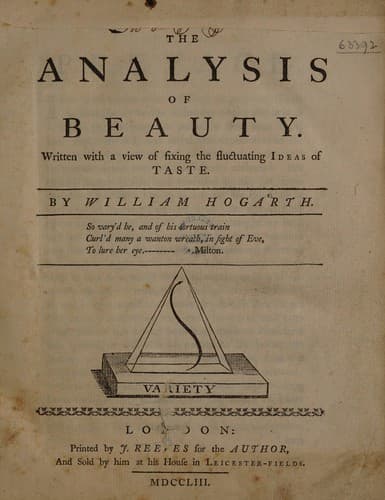
The Analysis of Beauty: Written with a view of fixing the fluctuating ideas of tasteHogarth, William
Philosophy
The Analysis of Beauty: Written with a view of fixing the fluctuating ideas of taste
Hogarth, William
Aesthetics -- Early works to 1800
These two master-pieces of art, are seen together in the same palace
at Rome, where the Antinous fills the spectator with admiration only,
whilst the Apollo strikes him with surprise, and, as travellers
express themselves, with an appearance of something _more than
human_; which they _of course_ are always at a loss to describe: and
this effect, they say, is the more astonishing, as upon examination
its disproportion is evident even to a common eye. One of the best
sculptors we have in England, who lately went to see them, confirm'd to
me what has been now said, particularly as to the legs and thighs being
too long, and too large for the upper parts. And Andrea Sacchi, one of
the great Italian painters, seems to have been of the same opinion,
or he would hardly have given his Apollo, crowning Pasquilini the
musician, the exact proportion of the Antinous, (in a famous picture of
his now in England) as otherwise it seems to be a direct copy from the
Apollo.
Although in very great works we often see an inferior part neglected,
yet here it cannot be the case, because in a fine statue, just
proportion is one of its essential beauties: therefore it stands
to reason, that these limbs must have been lengthened on purpose,
otherwise it might easily have been avoided.
So that if we examine the beauties of this figure thoroughly, we
may reasonably conclude, that what has been hitherto thought so
unaccountably _excellent_ in its general appearance, hath been owing to
what hath seem'd a _blemish_ in a part of it: but let us endeavour to
make this matter as clear as possible, as it may add more force to what
has been said.
Statues by being bigger than life, (as this is one, and larger than
the Antinous) always gain some nobleness in effect, according to the
principle of quantity[10] but this alone is not sufficient to give what
is properly to be called, _greatness_ in proportion; for were figures
17 and 18, in plate I, to be drawn or carved by a scale of ten feet
high, they would still be but pigmy proportions, as, on the other hand,
a figure of but two inches, may represent a gigantic height.
[Illustration: Figs. 17 and 18]
[10] See Chapter VI.
Therefore _greatness_ of proportion must be considered, as depending
on the application of _quantity_ to those parts of the body where it
can give more scope to its grace in movement, as to the neck for the
larger and swan-like turns of the head, and to the legs and thighs, for
the more ample sway of all the upper parts together.
By which we find that the Antinous's being equally magnified to the
Apollo's height, would not sufficiently produce that superiority of
effect, as to greatness, so evidently seen in the latter. The additions
necessary to the production of this _greatness_ in proportion, as it
there appears added to grace, must then be, by the proper application
of them, to the parts mention'd only.
Public-domain text, read in full here on John Shaqi.
Reviews
Reviews
No reviews yet
Be the first to share your thoughts on this work.
Join the Discussion
Join the discussion
Sign in to leave a comment or review.
Sign InorCreate an account