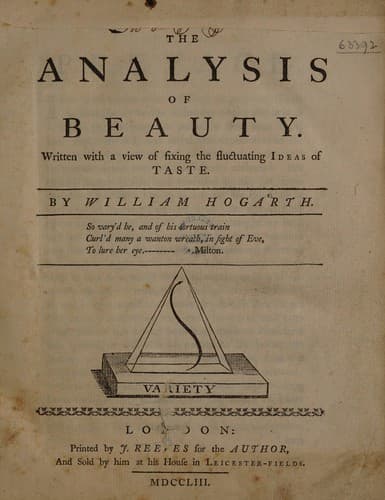
The Analysis of Beauty: Written with a view of fixing the fluctuating ideas of tasteHogarth, William
Philosophy
The Analysis of Beauty: Written with a view of fixing the fluctuating ideas of taste
Hogarth, William
Aesthetics -- Early works to 1800
I know not how further to prove this matter than by appealing to the
reader's eye, and common observation, as before.
The Antinous being allowed to have the justest proportion possible, let
us see what addition, upon the principle of quantity, can be made to
it, without taking away any of its beauty.
If we imagine an addition of dimensions to the head, we shall
immediately conceive it would only deform--if to the hands or feet,
we are sensible of something gross and ungenteel,--if to the whole
lengths of the arms, we feel they would be dangling and aukward--if by
an addition of length or breadth to the body, we know it would appear
heavy and clumsy--there remains then only the _neck_, with the _legs_
and _thighs_ to speak of; but, to these we find, that not only certain
additions may be admitted without causing any disagreeable effect, but
that thereby _greatness_, the last perfection as to proportion, is
given to the human form; as is evidently express'd in the Apollo: and
may still be further confirmed by examining the drawings of Parmigiano,
where these particulars are seen in excess; yet on this account his
works are said, by all true connoisseurs, to have an inexpressible
greatness of taste in them, though otherwise very incorrect.
Let us now return to the two general ideas we set out with at the
beginning of this chapter, and recollect that under the first, on
surface, I have shewn in what manner, and how far human proportion
is measureable, by varying the contents of the body, conformable to
the given proportion of two lines. And that under the second and more
extensive general idea of form, as arising from fitness for movement,
&c. I have endeavour'd to explain, by every means I could devise, that
every particular and minute dimension of the body, should conform to
such purposes of movement, &c. as have been first properly considered
and determined: on which conjunctively, the true proportion of every
character must depend; and is found so to do, by our joint-sensation
of bulk and motion. Which account of the proportion of the human
body, however imperfect, may possibly stand its ground, till one more
plausible shall be given.
As the Apollo [Fig. 12 p. I] has been only mention'd on account of
the greatness of its proportion, I think in justice to so fine a
performance; and also as it is not foreign to the point we have been
upon, we may subjoin an Observation or two on its perfections.
[Illustration: Fig. 12]
Public-domain text, read in full here on John Shaqi.
Reviews
Reviews
No reviews yet
Be the first to share your thoughts on this work.
Join the Discussion
Join the discussion
Sign in to leave a comment or review.
Sign InorCreate an account