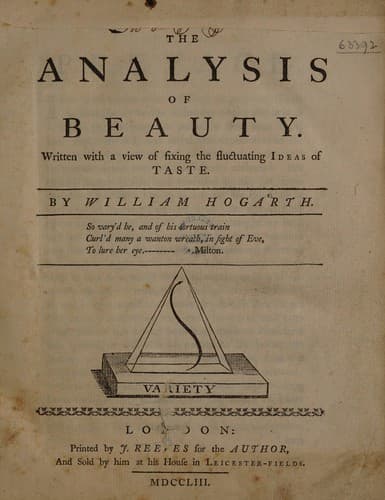
The Analysis of Beauty: Written with a view of fixing the fluctuating ideas of tasteHogarth, William
Philosophy
The Analysis of Beauty: Written with a view of fixing the fluctuating ideas of taste
Hogarth, William
Aesthetics -- Early works to 1800
Besides, what is commonly allow'd, if we consider it by the rules here
given for constituting or composing character, it will discover the
author's great sagacity, in choosing a proportion for this deity, which
has served two noble purposes at once; in that these very dimensions
which appear to have given it so much dignity, are the same that are
best fitted to produce the utmost speed. And what could characterise
the god of day, either so strongly or elegantly, to be expressive in a
statue, as superior swiftness, and beauty dignify'd? and how poetically
doth the action it is put into, carry on the allusion to speed,[11] as
he is lightly stepping forward, and seeming to shoot his arrows from
him; if the arrows may be allowed to signify the sun's rays? This at
least may as well be supposed as the common surmise, that he is killing
the dragon, Python; which certainly is very inconsistent with so erect
an attitude, and benign an aspect[12].
[11]----the sun: which cometh forth as a bridegroom out of his chamber,
and rejoiceth as a giant to run his course. Psalm xix. 5.
[12] The accounts given, in relation to this statue, make it so highly
probable that it was the great Apollo of Delphos, that, for my own
part, I make no manner of doubt of its being so.
Nor are the inferior parts neglected: the drapery also that depends
from his shoulders, and folds over his extended arm, hath its treble
office. As first, it assists in keeping the general appearance within
the boundary of a pyramid, which being inverted, is, for a single
figure, rather more natural and genteel than one upon its basis.
Secondly, it fills up the vacant angle under the arm, and takes off the
straightness of the lines the arm necessarily makes with the body in
such an action; and, lastly, spreading as it doth, in pleasing folds,
it helps to satisfy the eye with a noble quantity in the composition
altogether, without depriving the beholder of any part of the beauties
of the naked: in short, this figure might serve, were a lecture to be
read over it, to exemplify every principle that hath been hitherto
advanced. We shall therefore close not only all we have to say on
proportion with it, but our whole lineal account of form, except what
we have particularly to offer as to the face; which it will be proper
to defer, till we have spoken of _light_ and _shade_ and _colour_.
As some of the ancient statues have been of such singular use to me, I
shall beg leave to conclude this chapter with an observation or two on
them in general.
Public-domain text, read in full here on John Shaqi.
Reviews
Reviews
No reviews yet
Be the first to share your thoughts on this work.
Join the Discussion
Join the discussion
Sign in to leave a comment or review.
Sign InorCreate an account