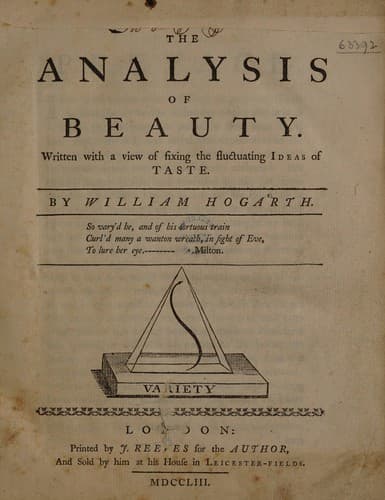
The Analysis of Beauty: Written with a view of fixing the fluctuating ideas of tasteHogarth, William
Philosophy
The Analysis of Beauty: Written with a view of fixing the fluctuating ideas of taste
Hogarth, William
Aesthetics -- Early works to 1800
Here again our other senses must assist us, notwithstanding in this
chapter we shall be more confined to what is communicated to the eye by
rays of light; and tho' things must now be consider'd as appearances
only; produced and made out merely by means of _lights, shades,_ and
_colours_.
By the various circumstances of which, every one knows we have
represented on the flat surface of the looking-glass, pictures equal to
the originals reflected by it. The painter too, by proper dispositions
of lights, shades, and colours, on his canvas, will raise the like
ideas. Even prints, by means of lights and shades alone, will perfectly
inform the eye of every shape and distance whatsoever, in which even
lines must be consider'd as narrow parts of shade, a number of them,
drawn or engrav'd neatly side by side, called _hatching_, serve as
shades in prints, and when they are artfully managed, are a kind of
pleasing _succedaneum_ to the delicacy of nature's.
Could mezzo-tinto prints be wrought as accurately as those with the
graver, they would come nearest to nature, because they are done
without strokes or lines.
I have often thought that a landskip, in the process of this way of
representing it, doth a little resemble the first coming on of day.
The copper-plate it is done upon, when the artist first takes it into
hand, is wrought all over with an edg'd-tool, so as to make it print
one even black, like night: and his whole work after this, is merely
introducing the lights into it; which he does by scraping off the rough
grain according to his design, artfully smoothing it most where light
is most required: but as he proceeds in burnishing the lights, and
clearing up the shades, he is obliged to take off frequent impressions
to prove the progress of the work, so that each proof appears like the
different times of a foggy morning, till one becomes so finish'd as to
be distinct and clear enough to imitate a day-light piece. I have given
this description because I think the whole operation, in the simplest
manner, shews what lights and shades alone will do.
As light must always be supposed, I need only speak of such privations
of it as are called shades or shadows, wherein I shall endeavour to
point out and regularly describe a certain order and arrangement in
their appearance, in which order we may conceive different kinds of
softnings and modulations of the rays of light which are said to fall
upon the eye from every object it sees, and to cause those more or
less-pleasing vibrations of the optic nerves, which serve to inform the
mind concerning every different shape or figure that presents itself.
Public-domain text, read in full here on John Shaqi.
Reviews
Reviews
No reviews yet
Be the first to share your thoughts on this work.
Elsewhere in the archive
Join the Discussion
Join the discussion
Sign in to leave a comment or review.
Sign InorCreate an account