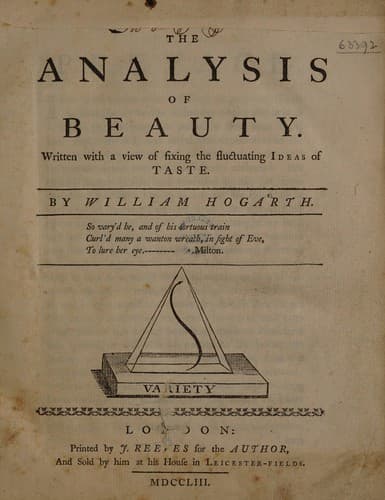
The Analysis of Beauty: Written with a view of fixing the fluctuating ideas of tasteHogarth, William
Philosophy
The Analysis of Beauty: Written with a view of fixing the fluctuating ideas of taste
Hogarth, William
Aesthetics -- Early works to 1800
The best light for seeing the shadows of objects truly, is, that which
comes in at a common sized window, where the sun doth not shine; I
shall therefore speak of their order as seen by this kind of light:
and shall take the liberty in the present and following chapter, to
consider colours but as variegated shades, which together with common
shades, will now be divided into two general parts or branches.
The first we shall call PRIME TINTS, by which is meant any colour or
colours on the surfaces of objects; and the use we shall make of these
different hues will be to consider them as shades to one another. Thus
gold is a shade to silver, &c. exclusive of those additional shades
which may be made in any degree by the privation of light.
The second branch may be called RETIRING SHADES, which gradate or go
off by degrees, as figs. [84 and 85 T p. II]. These shades, as they vary
more or less, produce beauty, whether they are occasioned by the
privation of light, or made by the pencilings of art or nature.
[Illustration: Figs. 84 and 85]
When I come to treat of colouring, I shall particularly shew in what
manner the gradating of prime tints serve to the making a beautiful
complexion; in this place we shall only observe how nature hath by
these gradating shades ornamented the surfaces of animals; fish
generally have this kind of shade from their backs downward; birds have
their feathers enriched with it; and many flowers, particularly the
rose, shew it by the gradually-increasing colours of their leaves.
The sky always gradates one way or other, and the rising or setting
sun exhibits it in great perfection, the imitating of which was Claud.
de Loraine's peculiar excellence, and is now Mr. Lambert's: there is so
much of what is called harmony to the eye to be produced by this shade,
that I believe we may venture to say, in art it is the painter's gamut,
which nature has sweetly pointed out to us in what we call the eyes of
a peacock's tail: and the nicest needle-workers are taught to weave it
into every flower and leaf, right or wrong, as if it was as constantly
to be observed as it is seen in flames of fire; because it is always
found to entertain the eye. There is a sort of needle-work called
Irish-stitch, done in these shades only; which pleases still, tho' it
has long been out of fashion.
There is so strict an analogy between shade and sound, that they
may well serve to illustrate each other's qualities: for as sounds
gradually decreasing and increasing give the idea of progression from,
or to the ear, just so do retiring shades shew progression, by figuring
it to the eye. Thus, as by objects growing still fainter, we judge
of distances in prospects, so by the decreasing noise of thunder, we
form the idea of its moving further from us. And with regard to their
similitude in beauty, like as the gradating shade pleases the eye, so
the increasing, or swelling note, delights the ear.
Public-domain text, read in full here on John Shaqi.
Reviews
Reviews
No reviews yet
Be the first to share your thoughts on this work.
Elsewhere in the archive
Join the Discussion
Join the discussion
Sign in to leave a comment or review.
Sign InorCreate an account