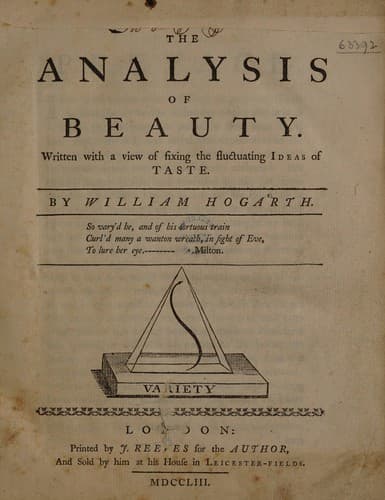
The Analysis of Beauty: Written with a view of fixing the fluctuating ideas of tasteHogarth, William
Philosophy
The Analysis of Beauty: Written with a view of fixing the fluctuating ideas of taste
Hogarth, William
Aesthetics -- Early works to 1800
But it will be proper to premise, that when it is quite shut, and
flat or parallel to the eye and window, it will have only a penciling
shade gradating upon it, and spreading all around from the middle, but
which will not have the power of giving the idea of recession any way,
as when it opens, and the lines run in perspective to a point; because
the square figure or parallel lines of the door, do not correspond with
such shade; but let a door be circular in the same situation, and all
without side, or round about it, painted of any other colour, to make
its figure more distinctly seen, and it will immediately appear concave
like a bason, the shade continually retiring; because this circular
species of shade would then be accompanied by its corresponding form, a
circle[14].
[14] Note, if the light were to come in at a very little hole not far
from the door, so as to make the gradation sudden and strong, like what
may be made with a small candle held near a wall or a wainscot, the
bason would appear the deeper for it.
Note also, that when planes are seen parallel to the eye in open
day-light, they have scarce any round gradating or penciling shade
at all, but appear merely as uniform prime tints, because the rays
of light are equally diffused upon them. Nevertheless, give them but
obliquity, they will more or less exhibit the retiring shade.
But to return; we observ'd that all the degrees of obliquity in the
moving of planes or flat surfaces, have the appearances of their
recession perfected to the eye by the first species of retiring shade.
For example, then; when the door opens, and goes from its parallel
situation with the eye, the shade last spoken of, may be observed to
alter and change its round gradating appearance, into that of gradating
one way only; as when a standing water takes a current upon the least
power given it to descend.
Note, if the light should come in at the door-way, instead of the
window, the gradation then would be reversed but still the effect of
recession would be just the same, as this shade ever complies with the
perspective lines.
In the next place, let us observe the _ovolo_, or quarter-round in
a cornice, fronting the eye in like manner, by which may be seen an
example of the second species; where, on its most projecting part, a
line of light is seen, from whence these shades retire contrary ways,
by which the curvature is understood.
Public-domain text, read in full here on John Shaqi.
Reviews
Reviews
No reviews yet
Be the first to share your thoughts on this work.
Elsewhere in the archive
Join the Discussion
Join the discussion
Sign in to leave a comment or review.
Sign InorCreate an account