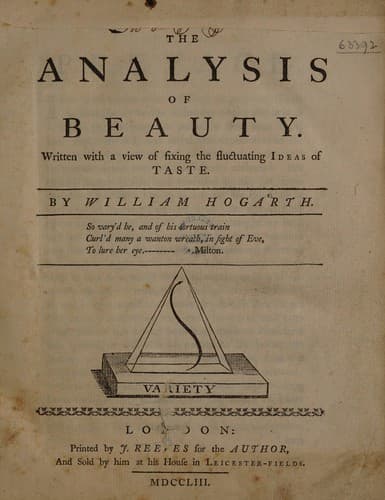
The Analysis of Beauty: Written with a view of fixing the fluctuating ideas of tasteHogarth, William
Philosophy
The Analysis of Beauty: Written with a view of fixing the fluctuating ideas of taste
Hogarth, William
Aesthetics -- Early works to 1800
But in order to the better and more precisely fixing upon what may be
there seen, as the distinct species, of which all the shades of the
retiring kind in nature partake, in some degree or other, the following
scheme is offered, and intended as an additional means of making such
simple impressions in the mind, as may be thought adequate to the four
species of lines described in Chapter VII. Wherein we are to suppose
imperceptible degrees of shade gradating from one figure to another.
The first species to be represented by, 1, 2, 3, 4, 5.
the second by, 5, 4, 3, 2, 1, 2, 3, 4, 5.
and the third by, 5, 4, 3, 2, 1, 2, 3, 4, 5, 4, 3, 2, 1, 2, 3, 4, 5.
gradating from the dots underneath, repeated either way.
As the first species varies or gradates but one way, it is therefore
least ornamental, and equal only to straight lines.
The second gradating contrary ways, doubling the others variety, is
consequently twice as pleasing, and thereby equal to curved lines.
The third species gradating doubly contrary ways, is thereby still
more pleasing in proportion to that quadruple variety which makes it
become capable of conveying to the mind an equivalent in shade, which
expresses the beauty of the waving line, when it cannot be seen as a
line.
The retiring shade, adequate to the serpentine line, now should follow;
but as the line itself could not be expressed on paper, without the
figure of a cone [Fig. 26 p. I], so neither can this shade be described
without the assistance of a proper form, and therefore must be deferred
a little longer.
[Illustration: Fig. 26]
When only the ornamental quality of shades is spoken of, for the sake
of distinguishing them from retiring shades, let them be considered as
pencilings only; whence another advantage will arise, which is, that
then all the intervening mixtures, with their degrees of beauty between
each species, may be as easily conceived, as those have been between
each class of lines.
And now let us have recourse to the experiments in life, for such
examples as may explain the retiring power of each species; since, as
has been before observed, they must be considered together with their
proper forms, or else their properties cannot be well distinguished.
All the degrees of obliquity that planes, or flat surfaces are capable
of moving into, have their appearances of recession perfected by the
first species of retiring shades, which may evidently be seen by
setting opposite a door, as it is opening outwards from the eye, and
fronting one light.
Public-domain text, read in full here on John Shaqi.
Reviews
Reviews
No reviews yet
Be the first to share your thoughts on this work.
Elsewhere in the archive
Join the Discussion
Join the discussion
Sign in to leave a comment or review.
Sign InorCreate an account