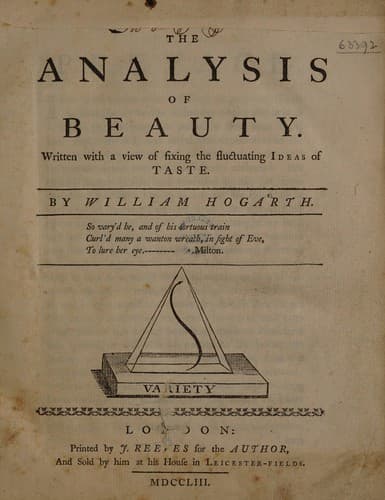
The Analysis of Beauty: Written with a view of fixing the fluctuating ideas of tasteHogarth, William
Philosophy
The Analysis of Beauty: Written with a view of fixing the fluctuating ideas of taste
Hogarth, William
Aesthetics -- Early works to 1800
[15] Note, though I have advised the observing objects by a front
light, for the sake of the better distinguishing our four fundamental
species of shades, yet objects in general are more advantagiously,
and agreeably seen by light coming side-ways upon them, and therefore
generally chose in paintings; as it gives an additional reflected
softness, not unlike the gentle tone of an echo in music.
[16] As an instance that convex and concave would appear the same, if
the former were to have no reflection thrown upon, observe the ovolo
and cavetto, or channel, in a cornice, placed near together, and seen
by a front light, when they will each of them, by turns, appear either
concave, or convex, as fancy shall direct.
I have now only to add, that as before observed, Chapter IV, page 23,
that the oval hath a noble simplicity in it, more equal to its variety
than any other object in nature; and of which the general form of a
face is composed; therefore, from what has been now shewn, the general
gradation-shade belonging to it, must consequently be adequate thereto,
and which evidently gives a delicate softness to the whole composition
of a face; insomuch that every little dent, crack, or scratch, the
form receives, its shadows also suffer with it, and help to shew the
blemish. Even the least roughness interrupts and damages that soft
gradating play of shades which fall upon it. Mr. Dryden, describing the
light and shades of a face, in his epistle to Sir Godfrey Kneller the
portrait painter, seems, by the penetration of his incomparable genius,
to have understood that language in the works of nature, which the
latter, by means of an exact eye and a strict obeying hand, could only
faithfully transcribe; when he says,
Where light to shades descending, plays, not strives,
Dies by degrees, and by degrees revives.
CHAPTER XIII.
_Of COMPOSITION with regard to LIGHT, SHADE and COLOURS_.
Under this head I shall attempt shewing what it is that gives the
appearance of that hollow or vacant space in which all things move so
freely; and in what manner light, shade and colours, mark or point out
the distances of one object from another, and occasion an agreeable
play upon the eye, called by the painters a fine keeping, and pleasing
composition of light and shade. Herein my design is to consider this
matter as a performance of nature _without_, or before the eye; I mean,
as if the objects with their shades, &c. were in fact circumstanced
as they appear, and as the unskill'd in optics take them to be. And
let it be remarked throughout this chapter, that the pleasure arising
from composition, as in a fine landskip, &c. is chiefly owing to the
dispositions and assemblages of light and shades, which are so order'd
by the principles called OPPOSITION, BREADTH and SIMPLICITY, as to
produce a just and distinct perception of the objects before us.
Public-domain text, read in full here on John Shaqi.
Reviews
Reviews
No reviews yet
Be the first to share your thoughts on this work.
Elsewhere in the archive
Join the Discussion
Join the discussion
Sign in to leave a comment or review.
Sign InorCreate an account