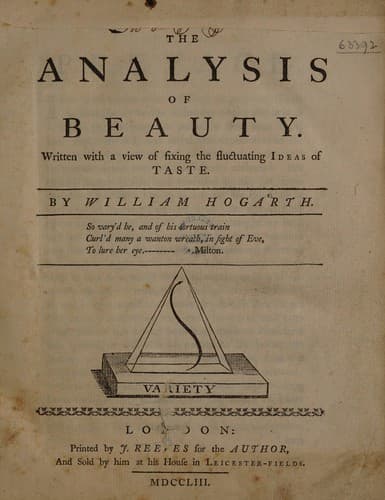
The Analysis of Beauty: Written with a view of fixing the fluctuating ideas of tasteHogarth, William
Philosophy
The Analysis of Beauty: Written with a view of fixing the fluctuating ideas of taste
Hogarth, William
Aesthetics -- Early works to 1800
Experience teaches us that the eye may be subdued and forced into
forming and disposing of objects even quite contrary to what it would
naturally see them, by the prejudgment of the mind from the better
authority of feeling, or some other persuasive motive. But surely this
extraordinary perversion of the sight would not have been suffer'd,
did it not tend to great and necessary purposes, in rectifying some
deficiencies which it would otherwise be subject to (tho' we must own
at the same time, that the mind itself may be so imposed upon as to
make the eye see falsely as well as truly) for example, were it not
for this controul over the sight, it is well known, that we should not
only see things double, but upside down, as they are painted upon the
retina, and as each eye has a distinct sight. And then as to distances;
a fly upon a pane of glass is sometimes imagined a crow, or larger
bird afar off, till some circumstance hath rectified the mistake, and
convinced us of its real size and place.
Hence I would infer, that the eye generally gives its assent to such
space and distances as have been first measured by the feeling, or
otherwise calculated in the mind: which measurements and calculations
are equally, if not more, in the power of a blind man, as was fully
experienced by that incomparable mathematician and wonder of his age,
the late professor Sanderson.
By pursuing this observation on the faculties of the mind, an idea
may be formed of the means by which we attain to the perception or
appearance of an immense space surrounding us; which cavity, being
subject to divisions and subdivisions in the mind, is afterwards
fashioned by the limited power of the eye, first into a hemisphere, and
then into the appearance of different distances, which are pictured to
it by means of such dispositions of light and shade as shall next be
described. And these I now desire may be looked upon, but as so many
_marks_ or _types_ set upon these distances, and which are remember'd
and learnt by degrees, and when learnt, are recurred to upon all
occasions.
If permitted then to consider light and shades as _types of
distinction_, they become, as it were, our materials, of which _prime
tints_ are the principal; by these, I mean the fixed and permanent
colours of each object, as the green of trees, &c. which serve the
purposes of separating and relieving the several objects by the
different strengths or shades of them being opposed to each other [Fig.
86 T p. II].
[Illustration: Fig. 86]
Public-domain text, read in full here on John Shaqi.
Reviews
Reviews
No reviews yet
Be the first to share your thoughts on this work.
Elsewhere in the archive
Join the Discussion
Join the discussion
Sign in to leave a comment or review.
Sign InorCreate an account