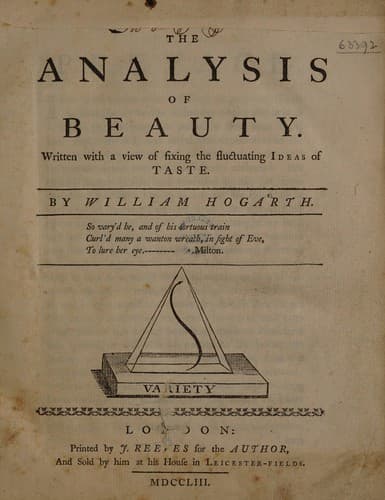
The Analysis of Beauty: Written with a view of fixing the fluctuating ideas of tasteHogarth, William
Philosophy
The Analysis of Beauty: Written with a view of fixing the fluctuating ideas of taste
Hogarth, William
Aesthetics -- Early works to 1800
[18] Notwithstanding the deep-rooted notion, even among the majority of
painters themselves, that time is a great improver of good pictures,
I will undertake to shew, that nothing can be more absurd. Having
mention'd above the whole effect of the oil, let us now see in what
manner time operates on colours themselves; in order to discover if any
changes in them can give a picture more union and harmony than has been
in the power of a skilful master, with all his rules of art, to do.
When colours change at all it must be somewhat in the manner following,
for as they are made some of metal, some of earth, some of stone,
and others of more perishable materials, time cannot operate on them
otherwise than as by daily experience we find it doth, which is, that
one changes darker, another lighter, one quite to a different colour,
whilst another, as ultramarine, will keep its natural brightness
even in the fire. Therefore how is it possible that such different
materials, ever variously changing (visibly after a certain time)
should accidentally coincide with the artist's intention, and bring
about the greater harmony of the piece, when it is manifestly contrary
to their nature, for do we not see in most collections that much time
disunites, untunes, blackens, and by degrees destroys even the best
preserved pictures.
But if for argument sake we suppose, that the colours were to fall
equally together, let us see what advantage this would give to any sort
of composition. We will begin with a flower-piece: when a master hath
painted a rose, a lily, an african, a gentianella, or violet, with
his best art, and brightest colours, how far short do they fall of
the freshness and rich brillancy of nature; and shall we wish to see
them fall still lower, more faint, sullied, and dirtied by the hand
of time, and then admire them as having gained an additional beauty,
and call them mended and heightened, rather than fouled, and in a
manner destroy'd; how absurd! Instead of mellow and softened therefore,
always read yellow and sullied, for this is doing time the destroyer,
but common justice. Or shall we desire to see complexions, which in
life are often, literally, as brillant as the flowers above-mention'd,
served in the like ungrateful manner. In a landskip, will the water
be more transparent, or the sky shine with a greater lustre when
embrown'd and darken'd by decay? surely no. I own it would be a pity
that Mr. Addison's beautiful description of time at work in the gallery
of pictures, and the following lines of Mr. Dryden, should want a
sufficient foundation;--
For time shall with his ready pencil stand,
Retouch your figures with his ripening hand;
Mellow your colours, and imbrown the tint;
Add every grace which time alone can grant;
To future ages shall your fame convey,
And give more beauties than he takes away. Dryden to Kneller.
Public-domain text, read in full here on John Shaqi.
Reviews
Reviews
No reviews yet
Be the first to share your thoughts on this work.
Elsewhere in the archive
Join the Discussion
Join the discussion
Sign in to leave a comment or review.
Sign InorCreate an account