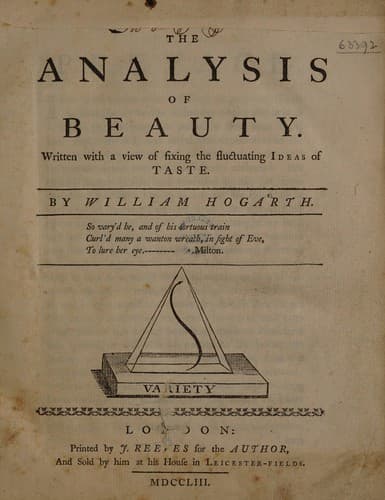
The Analysis of Beauty: Written with a view of fixing the fluctuating ideas of tasteHogarth, William
Philosophy
The Analysis of Beauty: Written with a view of fixing the fluctuating ideas of taste
Hogarth, William
Aesthetics -- Early works to 1800
But till children arrive at a reasoning age it will be difficult by any
means to teach them more grace than what is natural to every well made
child at liberty.
The grace of the upper parts of the body is most engaging, and
sensible well made people in any station naturally have it in a great
degree, therefore rules unless they are simple and easily retain'd and
practis'd, are of little use; nay, rather are of disservice.
Holding the head erect is but occasionally right, a proper recline of
it may be as graceful, but true elegance is mostly seen in the moving
it from one position to another.
And this may be attain'd by a sensibility within yourself, tho' you
have not a sight of what you do by looking in the glass, when with your
head assisted by a sway of the body in order to give it more scope, you
endeavour to make that very serpentine line in the air, which the hands
have been before taught to do by the help of the ogee-moulding: and I
will venture to say, a few careful repetitions at first setting out
will make this movement as easy to the head as to the hands and arms.
The most graceful bow is got by the head's moving in this direction,
as it goes downward and rises up again. Some aukward imitators of this
elegant way of bowing, for want of knowing what they were about, have
seem'd to bow with wry necks. The low solemn bow to majesty should
have but a very little twist, if any, as more becoming gravity and
submission. The clownish nod in a sudden straight line is quite the
reverse of these spoken of.
The most elegant and respectful curtesy hath a gentle, or small degree
of the above graceful bowing of the head as the person sinks, and
rises, and retreats. If it should be said, that a fine curtesy consists
in no more than in being erect in person at the time of sinking and
rising; Madam Catherine in clock-work, or the dancing bears led about
the streets for a shew, must be allow'd to make as good a curtesy as
anybody.
N. B. It is necessary in bowing and curtesying to shun an exact
sameness at all times; for however graceful it may be on some
occasions, at other times it may seem formal and improper. Shakespear
seems to have meant the above spoken of ornamental manner of bowing, in
Enobarbus's description of Cleopatra's waiting-women.----
----And made their bends adornings. Act 2.
3. Of _Dancing_. The minuet is allowed by the dancing-masters
themselves to be the perfection of all dancing. I once heard an
eminent dancing-master say, that the minuet had been the study of
his whole life, and that he had been indefatigable in the pursuit of
its beauties, yet at last he could only say with Socrates, _he knew
nothing_: adding, that I was happy in my profession as a painter, in
that some bounds might be set to the study of it. No doubt, as the
minuet contains in it a composed variety of as many movements in the
serpentine lines as can well be put together in distinct quantities, it
is a fine composition of movements.
Public-domain text, read in full here on John Shaqi.
Reviews
Reviews
No reviews yet
Be the first to share your thoughts on this work.
Elsewhere in the archive
Join the Discussion
Join the discussion
Sign in to leave a comment or review.
Sign InorCreate an account