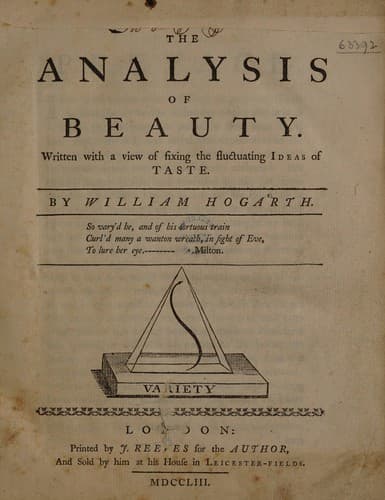
The Analysis of Beauty: Written with a view of fixing the fluctuating ideas of tasteHogarth, William
Philosophy
The Analysis of Beauty: Written with a view of fixing the fluctuating ideas of taste
Hogarth, William
Aesthetics -- Early works to 1800
I shall venture, lastly, to say a word or two of stage-action. From
what has been said of habitually moving in waving lines, it may
possibly be found that if stage-action, particularly the graceful,
were to be studied lineally, it might be more speedily and accurately
acquired by the help of the foregoing principles than the methods
hitherto taken. It is known that common deportment, such as may
pass for elegant and proper off the stage, would no more be thought
sufficient upon it than the dialogue of common polite conversation,
would be accurate or spirited enough for the language of a play. So
that trusting to chance only will not do. The actions of every scene
ought to be as much as possible a compleat composition of well varied
movements, considered as such abstractedly, and apart from what may
be merely relative to the sense of the words. Action consider'd with
regard to assisting the authors meaning, by enforcing the sentiments
or raising the passions, must be left entirely to the judgment of the
performer, we only pretend to shew how the limbs may be made to have an
equal readiness to move in all such directions as may be acquired.
What I would have understood by action, abstractedly and apart from
its giving force to the meaning of the words, may be better conceived
by supposing a foreigner, who is a thorough master of all the effects
of action, at one of our theatres, but quite ignorant of the language
of the play; it is evident his sentiments under such limitations,
would chiefly arise from what he might distinguish by the lines of the
movements belonging to each character; the actions of an old man, if
proper, or not, would be visible to him at once, and he would judge of
low and odd characters, by the inelegant lines which we have already
shewn to belong to the characters of punch, harlequin, pierrott, or
the clown; so he would also form his judgment of the graceful acting
of a fine gentleman, or hero, by the elegance of their movements in
such lines of grace and beauty as have been sufficiently described. See
chapters V, VI, VII, VIII, on the composition of forms. Where note,
that as the whole of beauty depends upon _continually varying_ the same
must be observed with regard to genteel and elegant acting: and as
plain space makes a considerable part of beauty in form, so cessation
of movement in acting is as absolutely necessary; and in my opinion
much wanted on most stages, to relieve the eye from what Shakespear
calls, _continually sawing the air_.
The actress hath sufficient grace with fewer actions, and those in
less extended lines than the actor; for as the lines that compose the
Venus are simpler and more gently flowing, than those that compose the
Apollo, so must her movements be in like proportion.
Public-domain text, read in full here on John Shaqi.
Reviews
Reviews
No reviews yet
Be the first to share your thoughts on this work.
Elsewhere in the archive
Join the Discussion
Join the discussion
Sign in to leave a comment or review.
Sign InorCreate an account