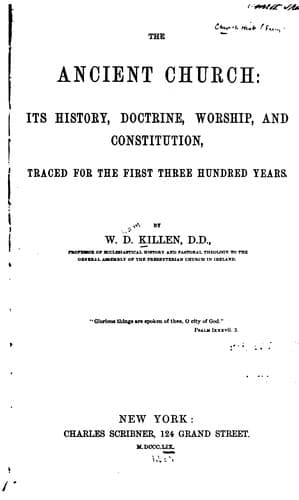
The Ancient Church: Its History, Doctrine, Worship, and ConstitutionKillen, W. D. (William Dool)
Religion
The Ancient Church: Its History, Doctrine, Worship, and Constitution
Killen, W. D. (William Dool)
Church history -- Primitive and early church, ca. 30-600
When Aquila and Priscilla were at Ephesus expounding "the way of God
more perfectly" to the Jew of Alexandria, Paul was travelling to
Jerusalem. Three years before, he had been there to confer with the
apostles and elders concerning the circumcision of the Gentiles; and he
had not since visited the holy city. His present stay seems to have been
short--apparently not extending beyond a few days at the time of the
feast of Pentecost,--and giving him a very brief opportunity of
intercourse with his brethren of the Jewish capital. He then "went down
to Antioch" [118:1]--a place with which from the commencement of his
missionary career he had been more intimately associated. "After he had
spent some time there, he departed and went over all the country of
Galatia and Phrygia in order, strengthening all the disciples." [118:2]
On a former occasion, after he had passed through the same districts, he
had been "forbidden of the Holy Ghost to preach the word in (the
Proconsular) Asia;" [118:3] but, at this time, the restriction was
removed, and in accordance with the promise made to the Jews at Ephesus
in the preceding spring, he now resumed his evangelical labours in that
far-famed metropolis. There must have been a strong disposition on the
part of many of the seed of Abraham in the place to attend to his
instructions, as he was permitted "for the space of _three months_" to
occupy the synagogue, "disputing and persuading the things concerning
the kingdom of God." [118:4] At length, however, he began to meet with
so much opposition that he found it expedient to discontinue his
addresses in the Jewish meeting-house. "When divers were hardened and
believed not, but spake evil of that way before the multitude, he
departed from them, and separated the disciples, disputing daily in the
school of one Tyrannus." [118:5] This Tyrannus was, in all probability,
a Gentile convert, and a teacher of rhetoric--a department of education
very much cultivated at that period by all youths anxious to attain
social distinction. What is here called his "school," appears to have
been a spacious lecture-room sufficient to accommodate a numerous
auditory.
Public-domain text, read in full here on John Shaqi.
Reviews
Reviews
No reviews yet
Be the first to share your thoughts on this work.
Elsewhere in the archive
Join the Discussion
Join the discussion
Sign in to leave a comment or review.
Sign InorCreate an account