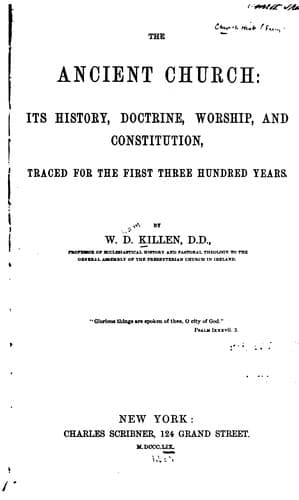
The Ancient Church: Its History, Doctrine, Worship, and ConstitutionKillen, W. D. (William Dool)
Religion
The Ancient Church: Its History, Doctrine, Worship, and Constitution
Killen, W. D. (William Dool)
Church history -- Primitive and early church, ca. 30-600
The Procurator was now placed in a somewhat awkward position; for, when
sending Paul to Rome, he was required at the same time to report the
crimes imputed to the prisoner; but the charges were so novel, and
apparently so frivolous, that he did not well know how to embody them in
an intelligible document. Meanwhile King Agrippa and his sister Bernice
came to Caesarea "to salute Festus," [138:3] that is, to congratulate
the new Governor on his arrival in the country; and the royal party
expressed a desire to hear what the apostle had to say in his
vindication. Agrippa was great-grandson of that Herod who reigned in
Judea when Jesus was born in Bethlehem, and the son of the monarch of
the same name whose sudden and awful death is recorded in the twelfth
chapter of the Acts. On the demise of his father in A.D. 44, he was only
seventeen years of age; and Judea, which was then reduced into the form
a Roman province with Caesarea for its capital, had remained ever since
under the government of Procurators. But though Agrippa had not been
permitted to succeed to the dominions of his father, he had received
various proofs of imperial favour; for he had obtained the government,
first of the principality of Chalcis, and then of several other
districts; and he had been honoured with the title of King. [139:1] The
Gentile Procurators could not be expected to be very minutely acquainted
with the ritual and polity of Israel; but as Agrippa was a Jew, and
consequently familiar with the customs and sentiments of the native
population, he had been entrusted with the care of the temple and its
treasures, as well as with the appointment of the high priest. Festus,
no doubt, felt that in a case such as that of Paul, the advice of this
visitor should be solicited; and hoped that Agrippa would be able to
supply some suggestion to relieve him out of his present perplexity. It
was accordingly arranged that the apostle should be permitted to plead
his cause in the hearing of the Jewish monarch. The affair seems to have
created unusual interest; the public appear to have been partially
admitted on the occasion; and seldom, or, perhaps, never before, had
Paul enjoyed an opportunity of addressing such an influential and
brilliant auditory. "Agrippa came, and Bernice, _with great pomp_, and
entered into the place of hearing, with the chief captains, and
principal men of the city." [139:2] Paul, still in bonds, made his
appearance before this courtly throng; and though it might have been
expected that a two years' confinement would have broken the spirit of
the prisoner, he displayed powers of argument and eloquence which
astonished and confounded his judges. The Procurator was quite
bewildered by his reasoning, for he appealed to "the promise made unto
the fathers," [139:3] and to things which "Moses and the prophets did
say should come;" [140:1] and as Festus could not appreciate the lofty
enthusiasm of the Christian orator (for he had never, when at Rome, been
Public-domain text, read in full here on John Shaqi.
Reviews
Reviews
No reviews yet
Be the first to share your thoughts on this work.
Elsewhere in the archive
Join the Discussion
Join the discussion
Sign in to leave a comment or review.
Sign InorCreate an account