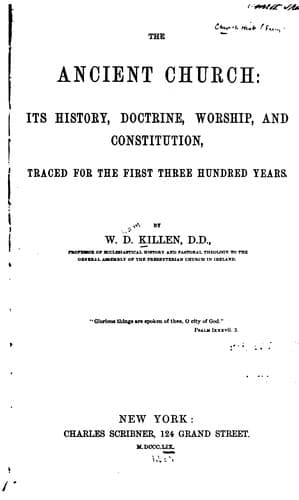
The Ancient Church: Its History, Doctrine, Worship, and ConstitutionKillen, W. D. (William Dool)
Religion
The Ancient Church: Its History, Doctrine, Worship, and Constitution
Killen, W. D. (William Dool)
Church history -- Primitive and early church, ca. 30-600
The important services he had been able to render on the voyage gave him
a claim to particular indulgence; and accordingly, when he reached Rome,
and when the centurion delivered the prisoners to the Praetorian
Prefect, or the commander-in-chief of the Praetorian guards, [147:4]
"Paul was suffered to dwell by himself with a soldier that kept him."
[147:5] But though he enjoyed this comparative liberty, he was chained
to his military care-taker, so that his position must still have been
very far from comfortable. And yet even thus he continued his ministry
with as much ardour as if he had been without restraint, and as if he
had been cheered on by the applause of his generation. Three days after
his arrival in the city he "called the chief of the Jews together,"
[148:1] and gave them an account of the circumstances of his committal,
and of his appeal to the imperial tribunal. They informed him that his
case had not been reported to them by their brethren in Judea; and then
expressed a desire to hear from him a statement of the claims of
Christianity. "And when they had appointed him a day, there came many to
him into his lodging; to whom he expounded and testified the kingdom of
God, persuading them concerning Jesus, both out of the law of Moses and
out of the prophets from morning till evening." [148:2] His appeals
produced a favourable impression upon only a part of his audience. "Some
believed the things which were spoken, and some believed not." [148:3]
Several years prior to this date a Christian Church existed in the
Western metropolis, and at this time there were probably several
ministers in the city; but the apostle, in all likelihood, now entered
upon some field of labour which had not hitherto been occupied. He
"dwelt two whole years in his own hired house, and received all that
came in unto him--preaching the kingdom of God, and teaching those
things which concern the Lord Jesus Christ with all confidence, no man
forbidding him." [148:4] All this time Paul's right hand was chained to
the left hand of a soldier, who was responsible for the safe keeping of
his prisoner. The soldiers relieved each other in this duty. [148:5] It
would appear that Paul's chain might be relaxed at meal-times, and
perhaps he was occasionally granted some little additional indulgence;
but day and night he and his care-taker must have remained in close
proximity, as the life of the soldier was forfeited should his ward
escape. We can well conceive that the very appearance of the preacher at
this period invited special attention to his ministrations. He was now
"Paul the aged;" [149:1] he had perhaps passed the verge of threescore
years; and though his detractors had formerly objected that "his bodily
presence was weak," [149:2] all would at this time have, probably,
admitted, that his aspect was venerable. His life had been a career of
unabated exertion; and now, though worn down by toils, and hardships,
Public-domain text, read in full here on John Shaqi.
Reviews
Reviews
No reviews yet
Be the first to share your thoughts on this work.
Elsewhere in the archive
Join the Discussion
Join the discussion
Sign in to leave a comment or review.
Sign InorCreate an account