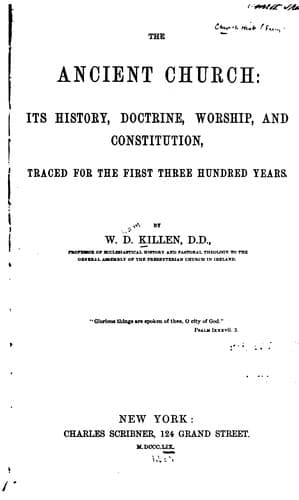
The Ancient Church: Its History, Doctrine, Worship, and ConstitutionKillen, W. D. (William Dool)
Religion
The Ancient Church: Its History, Doctrine, Worship, and Constitution
Killen, W. D. (William Dool)
Church history -- Primitive and early church, ca. 30-600
Many instances of their antipathy to the new sect have already been
noticed. In almost every town where the missionaries of the cross
appeared, the Jews "opposed themselves and blasphemed;" and magistrates
speedily discovered that in no way could they more easily gain the
favour of the populace than by inflicting sufferings on the Christians.
Hence, as we have seen, about the time of Paul's second visit to
Jerusalem after his conversion, Herod, the grandson of Herod the Great,
"killed James, the brother of John, with the sword; and because he saw
_it pleased the Jews,_ he proceeded further to take Peter also." [164:1]
The apostle of the circumcision was delivered by a miracle from his
grasp; but it is probable that other individuals of less note felt the
effects of his severity. Even in countries far remote from their native
land, the posterity of Abraham were the most bitter opponents of
Christianity. [164:2] As there was much intercourse between Palestine
and Italy, the gospel soon found its way to the seat of government; and
it has been conjectured that some civic disturbance created in the great
metropolis by the adherents of the synagogue, and intended to annoy and
intimidate the new sect, prompted the Emperor Claudius, about A.D. 53,
to interfere in the manner described by Luke, and to command "all Jews
to depart from Rome." [165:1] But the hostility of the Israelites was
most formidable in their own country; and for this, as well as other
reasons, "the brethren which dwelt in Judea" specially required the
sympathy of their fellow-believers throughout the Empire. When Paul
appeared in the temple at the feast of Pentecost in A.D. 58, the Jews,
as already related, made an attempt upon his life; and when the apostle
was rescued by the Roman soldiers, a conspiracy was formed for his
assassination. Four years afterwards, or about A.D. 62, [165:2] another
apostle, James surnamed the Just, who seems to have resided chiefly in
Jerusalem, finished his career by martyrdom. Having proclaimed Jesus to
be the true Messiah on a great public occasion, his fellow-citizens were
so indignant that they threw him from a pinnacle of the temple. As he
was still alive when he reached the ground, he was forthwith assailed
with a shower of stones, and beaten to pieces with the club of a fuller.
[165:3]
Public-domain text, read in full here on John Shaqi.
Reviews
Reviews
No reviews yet
Be the first to share your thoughts on this work.
Elsewhere in the archive
Join the Discussion
Join the discussion
Sign in to leave a comment or review.
Sign InorCreate an account