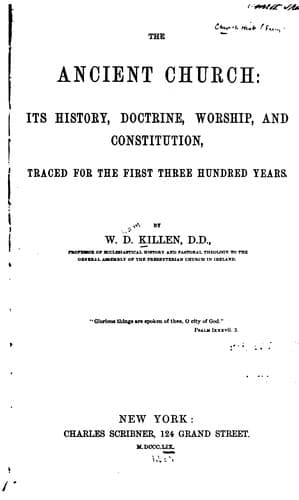
The Ancient Church: Its History, Doctrine, Worship, and ConstitutionKillen, W. D. (William Dool)
Religion
The Ancient Church: Its History, Doctrine, Worship, and Constitution
Killen, W. D. (William Dool)
Church history -- Primitive and early church, ca. 30-600
Two of the evangelists, Matthew and John, were apostles; and the other
two, Mark and Luke, appear to have been of the number of the Seventy.
[177:5] All were, therefore, fully competent to bear testimony to the
facts which they record, for the Seventy had "companied" with the Twelve
"all the time that the Lord Jesus went in and out among" them, [178:1]
and all "were from the beginning eye-witnesses and ministers of the
word." [178:2] These writers mention many miracles performed by Christ,
and at least three of the Gospels were in general circulation whilst
multitudes were still alive who are described in them as either the
spectators or the subjects of His works of wonder; and yet, though the
evangelists often enter most minutely into details, so that their
statements, if capable of contradiction, might have been at once
challenged and exposed, we do not find that any attempt was meanwhile
made to impeach their accuracy. Their manner of recording the acts of
the Great Teacher is characterised by remarkable simplicity, and the
most acute reader in vain seeks to detect in it the slightest trace of
concealment or exaggeration. Matthew artlessly confesses that he
belonged to the odious class of publicans; [178:3] Mark tells how Peter,
his friend and companion, "began to curse and to swear," and to declare
that he knew not the Man; [178:4] Luke, who was probably one of the two
brethren who journeyed to Emmaus, informs us how Jesus drew near to them
on the way and upbraided them as "fools and slow of heart to believe all
that the prophets had spoken;" [178:5] and John honestly repudiates the
pretended prediction setting forth that he himself was not to die.
[178:6] Each evangelist mentions incidents unnoticed by the others, and
thus supplies proof that he is entitled to the credit of an original and
independent witness. Matthew alone gives the formula of baptism "in the
name of the Father, and of the Son, and of the Holy Ghost;" [178:7] Mark
alone speaks of the great amazement of the people as they beheld the
face of Christ on His descent from the Mount of Transfiguration; [179:1]
Luke alone announces the appointment of the Seventy; [179:2] and John
alone records some of those sublime discourses in which our Lord treats
of the doctrine of His Sonship, of the mission of the Comforter, and of
the mysterious union between Himself and His people. [179:3] All the
evangelists direct our special attention to the scene of the
crucifixion. As they proceed to describe it, they obviously feel that
they are dealing with a transaction of awful import; and they
accordingly become more impressive and circumstantial. Their statements,
when combined, furnish a complete and consistent narrative of the sore
travail, the deep humiliation, and the dying utterances of the
illustrious sufferer.
Public-domain text, read in full here on John Shaqi.
Reviews
Reviews
No reviews yet
Be the first to share your thoughts on this work.
Elsewhere in the archive
Join the Discussion
Join the discussion
Sign in to leave a comment or review.
Sign InorCreate an account