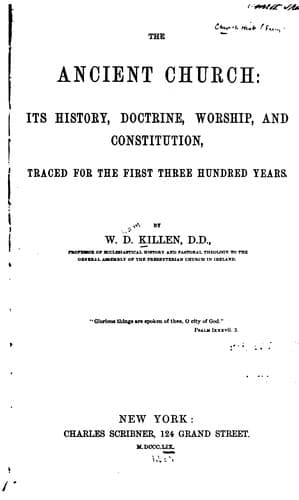
The Ancient Church: Its History, Doctrine, Worship, and ConstitutionKillen, W. D. (William Dool)
Religion
The Ancient Church: Its History, Doctrine, Worship, and Constitution
Killen, W. D. (William Dool)
Church history -- Primitive and early church, ca. 30-600
It thus appears that, with the exception of a few short epistles which
some hesitated to accredit, the New Testament, in the first century, was
acknowledged as the Word of God by all the Apostolical Churches. Its
various parts were not then included in a single volume; and as a
considerable time must have elapsed before copies of every one of them
were universally disseminated, it is not to be thought extraordinary if
the appearance of a letter, several years after it was written, and in
quarters where it had been previously unknown, awakened suspicion or
scepticism. But the slender objections, advanced under such
circumstances, gradually vanished before the light of additional
evidence; and it may safely be asserted that the whole of the documents,
now known as the Scriptures of the New Testament, were received, as
parts of a divine revelation, by an overwhelming majority of the early
Christians. The present division into chapters and verses was introduced
at a period comparatively recent; [184:2] but there is reason to believe
that stated portions of the writings of the apostles and evangelists
were read by the primitive disciples at their religious meetings, and
that, for the direction of the reader, as well as for the facility of
reference, the arrangement was soon notified in the manuscripts by
certain marks of distinction. [184:3] It is well known that in the
ancient Churches persons of all classes and conditions were encouraged
and required to apply themselves to the study of the sacred records;
that even children were made acquainted with the Scriptures; [185:1] and
that the private perusal of the inspired testimonies was considered an
important means of individual edification. All were invited and
stimulated by special promises to meditate upon the mysterious, as well
as the plain, passages of the book of Revelation. "Blessed," says the
Apostle John, "is he that readeth, and _they that hear the words of this
prophecy_, and keep those things which are written therein." [185:2]
Public-domain text, read in full here on John Shaqi.
Reviews
Reviews
No reviews yet
Be the first to share your thoughts on this work.
Elsewhere in the archive
Join the Discussion
Join the discussion
Sign in to leave a comment or review.
Sign InorCreate an account