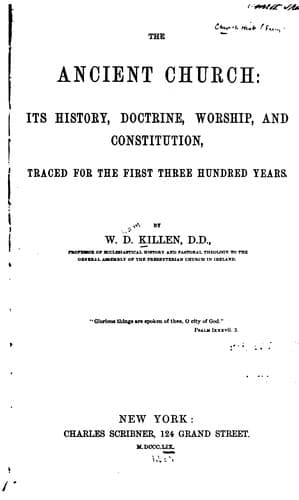
The Ancient Church: Its History, Doctrine, Worship, and ConstitutionKillen, W. D. (William Dool)
Religion
The Ancient Church: Its History, Doctrine, Worship, and Constitution
Killen, W. D. (William Dool)
Church history -- Primitive and early church, ca. 30-600
When the apostles first became disciples of the Son of Mary, their views
were certainly very indefinite and circumscribed. Acting under the
influence of strong attachment to the Wonderful Personage who exhibited
such wisdom and performed so many mighty works, they promptly obeyed the
invitation to come and follow Him; and yet when required to tell who was
this Great Teacher to whom they were attached by the charm of such a
holy yet mysterious fascination, they could do little more than declare
their conviction that Jesus was THE CHRIST. [189:3] They knew, indeed,
that the Messiah, or the Great Prophet, was to be a redeemer, and a
King; [189:4] but they did not understand how their lowly Master was to
establish His title to such high offices. [189:5] Though they "looked
for redemption," and "waited for the kingdom of God," [189:6] there was
much that was vague, as well as much that was visionary, in their
notions of the Redemption and the Kingdom. We may well suppose that the
views of the multitude were still less correct and perspicuous. Some,
perhaps, expected that Christ, as a prophet, would decide the
ecclesiastical controversies of the age; [189:7] others, probably,
anticipated that, as a Redeemer, he would deliver His countrymen from
Roman domination; [189:8] whilst others again cherished the hope that,
as a King, he would erect in Judea a mighty monarchy. [189:9] The
expectation that he would assert the possession of temporal dominion was
long entertained even by those who had been taught to regard Him as a
spiritual Saviour. [190:1]
During the interval between the resurrection and ascension, the apostles
profited greatly by the teaching of our Lord. "Then opened He their
understanding that they might understand the Scriptures," [190:2]
shewing that all things were "fulfilled which were written in the law of
Moses, and in the Prophets, and in the Psalms" [190:3] concerning Him.
The true nature of Christ's Kingdom was now fully disclosed to them;
they saw that the history of Jesus was embodied in the ancient
predictions; and thus their ideas were brought into harmony with the
revelations of the Old Testament. On the day of Pentecost they,
doubtless, received additional illumination; and thus, maturely
qualified for the duties of their apostleship, they began to publish the
great salvation. Even afterwards, their knowledge continued to expand;
for they had yet to be taught that the Gentiles also were heirs of the
Kingdom of Heaven; [190:4] that uncircumcised believers were to be
admitted to all the privileges of ecclesiastical fellowship; [190:5] and
that the ceremonial law had ceased to be obligatory. [190:6]
Public-domain text, read in full here on John Shaqi.
Reviews
Reviews
No reviews yet
Be the first to share your thoughts on this work.
Elsewhere in the archive
Join the Discussion
Join the discussion
Sign in to leave a comment or review.
Sign InorCreate an account