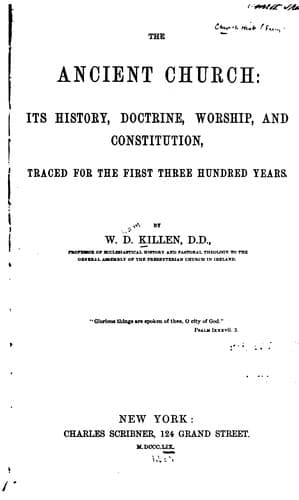
The Ancient Church: Its History, Doctrine, Worship, and ConstitutionKillen, W. D. (William Dool)
Religion
The Ancient Church: Its History, Doctrine, Worship, and Constitution
Killen, W. D. (William Dool)
Church history -- Primitive and early church, ca. 30-600
consulting the people as to the course to be pursued, he peremptorily
delivers his _judgment_, and requires them to hold a solemn
assembly that they may listen to the public announcement [225:4] of a
sentence of excommunication. He, of course, expected that their rulers
would concur with him in this decision, and that one of them would
officially publish it when they were "gathered together."
When the case is thus stated, it is easy to understand why the apostle
required all the disciples to "put away" from among themselves "that
wicked person." Had they continued to cherish the spirit which they had
recently displayed, they might either have encouraged the fornicator to
refuse submission to the sentence, or they might have rendered it
comparatively powerless. He therefore reminds them that they too should
seek to promote the purity of ecclesiastical fellowship; and that they
were bound to cooperate in carrying out a righteous discipline. They
were to cease to recognize this fallen disciple as a servant of Christ;
they were to withdraw themselves from his society; they were to decline
to meet him on the same terms, as heretofore, in social intercourse; and
they were not even to eat in his company. Thus would the reputation of
the Church be vindicated; for in this way it would be immediately known
to all who were without that he was no longer considered a member of the
brotherhood.
The Corinthians were awakened to a sense of duty by this apostolic
letter, and acted up to its instructions. The result was most
satisfactory. When the offender, saw that he was cut off from the
Church, and that its members avoided his society, he was completely
humbled. The sentence of the apostle, or the eldership, if opposed or
neglected by the people, might have produced little impression; but "the
punishment which was inflicted of many"--the immediate and entire
abandonment of all connexion with him by the disciples at
Corinth--overwhelmed him with shame and terror. He felt as a man smitten
by the judgment of God; he renounced his sin; and he exhibited the most
unequivocal tokens of genuine contrition. In due time he was restored to
Church fellowship; and the apostle then exhorted his brethren to readmit
him to intercourse, and to treat him with kindness and confidence. "Ye
ought," says he, "rather to forgive him and comfort him, lest perhaps
such an one should be swallowed up with overmuch sorrow. Wherefore I
beseech you that ye would confirm your love toward him." [227:1]
Public-domain text, read in full here on John Shaqi.
Reviews
Reviews
No reviews yet
Be the first to share your thoughts on this work.
Elsewhere in the archive
Join the Discussion
Join the discussion
Sign in to leave a comment or review.
Sign InorCreate an account