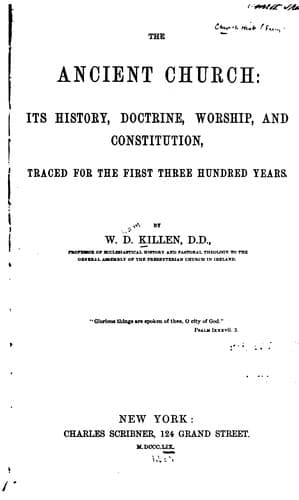
The Ancient Church: Its History, Doctrine, Worship, and ConstitutionKillen, W. D. (William Dool)
Religion
The Ancient Church: Its History, Doctrine, Worship, and Constitution
Killen, W. D. (William Dool)
Church history -- Primitive and early church, ca. 30-600
But though, according to the New Testament, the business of ruling
originally formed only a subordinate part of the duty of the church
teacher, some have maintained that ecclesiastical government pertains to
a higher function than ecclesiastical instruction; and that the apostles
instituted a class of spiritual overseers to whose jurisdiction all
other preachers are amenable. They imagine that, in the Pastoral
Epistles, they find proofs of the existence of such functionaries;
[238:3] and they contend that Timothy and Titus were diocesan bishops,
respectively of Ephesus and Crete. But the arguments by which they
endeavour to sustain these views are quite inconclusive. Paul says to
Timothy--"I besought thee to abide still at Ephesus, when I went into
Macedonia, that _thou mightest charge_ some that _they teach no other
doctrine_;" [239:1] and it has hence been inferred that the evangelist
was the only minister in the capital of the Proconsular Asia who was
sufficiently authorized to oppose heresiarchs. It happens, however, that
in this epistle the writer says also to his correspondent--"_Charge them
that are rich_ in this world that they be not high-minded, nor trust in
uncertain riches;" [239:2] so that, according to the same method of
interpretation, it would follow that Timothy was the only preacher in
the place who was at liberty to admonish the opulent. When Paul
subsequently stood face to face with the elders of Ephesus [239:3] he
told them that it was their common duty to discountenance and resist
false teachers; [239:4] and he had therefore now no idea of entrusting
that responsibility to any solitary individual. The reason why the
service was pressed specially on Timothy is sufficiently apparent. He
had been trained up by Paul himself; he was a young minister remarkable
for intelligence, ability, and circumspection; and he was accordingly
deemed eminently qualified to deal with the errorists. Hence at this
juncture his presence at Ephesus was considered of importance; and the
apostle besought him to remain there whilst he himself was absent on
another mission.
Public-domain text, read in full here on John Shaqi.
Reviews
Reviews
No reviews yet
Be the first to share your thoughts on this work.
Elsewhere in the archive
Join the Discussion
Join the discussion
Sign in to leave a comment or review.
Sign InorCreate an account