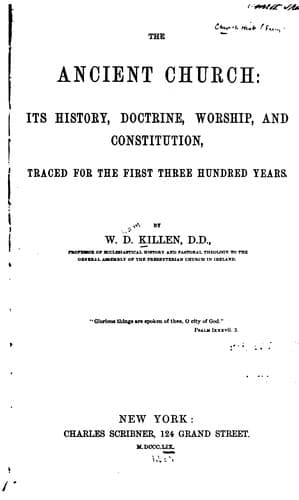
The Ancient Church: Its History, Doctrine, Worship, and ConstitutionKillen, W. D. (William Dool)
Religion
The Ancient Church: Its History, Doctrine, Worship, and Constitution
Killen, W. D. (William Dool)
Church history -- Primitive and early church, ca. 30-600
somewhat perilous; and it is probable that the ministers of the early
Christian Church did not deem it expedient to congregate in very large
numbers.
A single Scripture precedent for the regulation of the Church is as
decisive as a multitude; and though the New Testament distinctly records
only one instance in which a question of difficulty was referred by a
lower to a higher ecclesiastical tribunal, this case sufficiently
illustrates the character of the primitive polity. A very substantial
reason can be given why Scripture takes so little notice of the meetings
of Christian judicatories. The different portions of the New Testament
were put into circulation as soon as written; and though it was most
important that the heathen should be made acquainted with the doctrines
of the Church, it was not by any means expedient that their attention
should be particularly directed to the machinery by which it was
regulated. An accurate knowledge of its constitution would only have
exposed it more fearfully to the attacks of persecuting Emperors. Every
effort would have been made to discover the times and places of the
meetings of pastors and teachers, and to inflict a deadly wound on the
Church by the destruction of its office-bearers. Hence, in general, its
courts appear to have assembled in profound secrecy; and thus it is
that, for the first three centuries, so little is known of the
proceedings of these conventions.
It is to be observed that, in the first century, when the rulers of the
Church met for consultation, they all sat in the same assembly. When the
ecclesiastical constitution was fairly settled, even the Twelve were
disposed to waive their personal claims to precedence, and to assume the
status of ordinary ministers. We find accordingly that there were then
no higher and lower houses of convocation; for "the apostles and elders
came together." [255:1] Some, who suppose that James was the first
bishop of the holy city, imagine that in his manner of giving the advice
adopted at the Synod of Jerusalem, they can detect marks of his prelatic
influence. [255:2] But the sacred narrative, when candidly interpreted,
merely shews that he acted on the occasion as a judicious counsellor. He
was, assuredly, not entitled to dictate to Paul or Peter. The reasoning
of those who maintain that, as a matter of right, he expected the
meeting to yield to the weight of his official authority, would go to
prove, not that he was bishop of the Jewish capital, but that he was the
prince of the apostles.
Public-domain text, read in full here on John Shaqi.
Reviews
Reviews
No reviews yet
Be the first to share your thoughts on this work.
Elsewhere in the archive
Join the Discussion
Join the discussion
Sign in to leave a comment or review.
Sign InorCreate an account