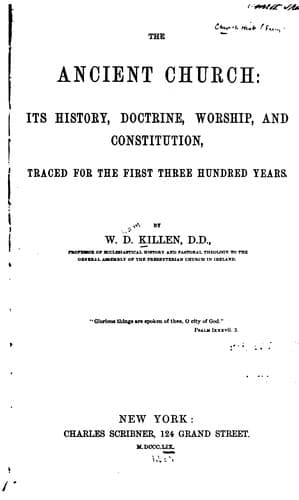
The Ancient Church: Its History, Doctrine, Worship, and ConstitutionKillen, W. D. (William Dool)
Religion
The Ancient Church: Its History, Doctrine, Worship, and Constitution
Killen, W. D. (William Dool)
Church history -- Primitive and early church, ca. 30-600
to other provincial cities. The address which he delivered to the
assembled elders certainly conveys the impression that they did not all
belong to the metropolis, and its very first sentence suggests such an
inference. "When they were come to him, he said unto them, Ye know from
the first day that I came _into Asia_ after what manner I have been
_with you_ at all seasons." [259:1] The evangelist informs us that he
had spent only two years and three months at Ephesus, [259:2] and yet he
here tells his audience that "by the space of _three years_" he had not
ceased to warn every one night and day with tears. [259:3] He says also
"I know that _ye all among whom I have gone_ preaching the kingdom of
God, shall see my face no more," [259:4]--thereby intimating that his
auditors were not resident in one locality. We have also distinct
evidence that when Paul formerly ministered at Ephesus, there were
Christian societies throughout the province, for in his First Epistle to
the Corinthians written from that city, [259:5] he sends his
correspondents the salutations of "the Churches of Asia." [259:6] These
Churches must obviously have been united by the ties of Christian
fellowship; and the apostle must have been in close communication with
them when he was thus employed as the medium of conveyance for the
expression of their evangelical attachment.
In other parts of the New Testament we may discern traces of
consociation among the primitive Churches. Thus, Paul, their founder,
sends to "the Churches of Galatia" [259:7] a common letter in which he
requires them to "serve one another," [259:8] and to "bear one another's
burdens." [259:9] Without some species of united action, the Galatians
could not well have obeyed such admonitions. Peter also, when writing to
the disciples "scattered throughout Pontus, Galatia, Cappadocia, Asia,
and Bithynia," [259:10] represents them as an associated body. "The
elders," says he, "which are among you I exhort, who am also an
elder....feed _the flock of God_ which is among you taking the oversight
thereof." [260:1] This "flock of God," which was evidently equivalent to
the "Church of God," [260:2] was spread over a large territory; and yet
the apostle suggests that the elders were conjointly charged with its
supervision. Had the Churches scattered throughout so many provinces
been a multitude of independent congregations, Peter would not have
described them as one "flock" of which these rulers had the oversight.
Public-domain text, read in full here on John Shaqi.
Reviews
Reviews
No reviews yet
Be the first to share your thoughts on this work.
Elsewhere in the archive
Join the Discussion
Join the discussion
Sign in to leave a comment or review.
Sign InorCreate an account