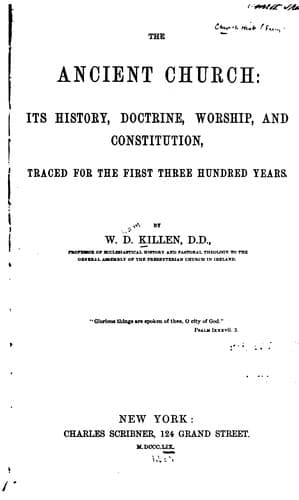
The Ancient Church: Its History, Doctrine, Worship, and ConstitutionKillen, W. D. (William Dool)
Religion
The Ancient Church: Its History, Doctrine, Worship, and Constitution
Killen, W. D. (William Dool)
Church history -- Primitive and early church, ca. 30-600
questioned whether the number of disciples in every one of these places
was then so limited as such an inference would suggest. In Laodicea, and
perhaps in one or two of the other cities, [266:3] there may have been
only a single congregation; but it is scarcely probable that all the
brethren in Ephesus still met together in one assembly. About forty
years before, the Word of God "grew mightily and prevailed" [266:4] in
that great metropolis; and, among its inhabitants, Paul had persuaded
"much people" [266:5] to become disciples of Christ. But if the angel of
the Church derived his title from the angel of the synagogue, and if the
position of these two functionaries was the same, we are shut up to the
conclusion that there was now only one congregation in the capital of
the Proconsular Asia. The angel could not be in two places at the same
time; and, as it was his duty to offer up the prayers of the assembled
worshippers, it was impossible for him to minister to two congregations.
These considerations abundantly attest the futility of the imagination
that the angel of the Church was a diocesan bishop. The office of the
angel of the synagogue had, in fact, no resemblance whatever to that of
a prelate. The rank of the ancient Jewish functionary seems to have been
similar to that of a precentor in some of our Protestant churches; and
when set forms of prayer were introduced among the Israelites, it was
his duty to read them aloud in the congregation. The angel was not the
chief ruler of the synagogue; he occupied a subordinate position; and
was amenable to the authority of the bench of elders. [267:1] It is in
vain then to attempt to recognise the predecessors of our modern
diocesans in the angels of the Seven Churches. Had bishops been
originally called angels, they never would have parted with so
complimentary a designation. Had the Spirit of God in the Apocalypse
bestowed upon them such a title, it never would have been laid aside.
When, about a century after this period, we begin to discover distinct
traces of a hierarchy, an extreme anxiety is discernible to find for it
something like a footing in the days of the apostles; but, strange to
say, the earliest prelates of whom we read are not known by the name of
angels. [267:2] If such a nomenclature existed in the time of the
Apostle John, it must have passed away at once and for ever! No trace of
it can be detected even in the second century. It is thus apparent that,
whatever the angels of the Seven Churches may have been, they certainly
were _not_ diocesan bishops.
Public-domain text, read in full here on John Shaqi.
Reviews
Reviews
No reviews yet
Be the first to share your thoughts on this work.
Elsewhere in the archive
Join the Discussion
Join the discussion
Sign in to leave a comment or review.
Sign InorCreate an account