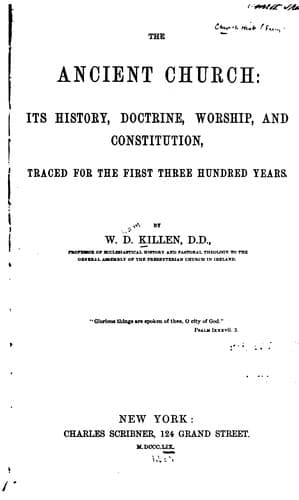
The Ancient Church: Its History, Doctrine, Worship, and ConstitutionKillen, W. D. (William Dool)
Religion
The Ancient Church: Its History, Doctrine, Worship, and Constitution
Killen, W. D. (William Dool)
Church history -- Primitive and early church, ca. 30-600
that the messengers undertook a most perilous errand when they engaged
to visit a distinguished Christian minister who had been driven into
banishment by a jealous tyrant; but they are taught by the vision that
they are under the special care of Him who is "the Prince of the kings
of the earth;" for the Saviour appears holding them in His right hand as
He walks in the midst of the seven golden candlesticks. When bearing
consolation to the aged minister, each one of them could enjoy the
comfort of the promise--"Can a woman forget her sucking child that she
should not have compassion on the son of her womb? Yea, they may forget,
yet will not I forget thee. _Behold, I have graven thee upon the palms
of my hands_." [271:2]
It has often been thought singular that only _seven_ Churches of the
Proconsular Asia are here addressed, as it is well known that, at this
period, there were several other Christian societies in the same
province. Thus, in the immediate neighbourhood of Laodicea were the
Churches of Colosse and Hierapolis; [271:3] and in the vicinity of
Ephesus, perhaps the Churches of Tralles and Magnesia. But the seven
angels mentioned by John may have been the only ecclesiastical
messengers in Patmos at the time of the vision; and they may have been
the organs of communication with a greater number of Churches than those
which they directly represented. Seven was regarded by the Jews as the
symbol of perfection; and it is somewhat remarkable that, on another
occasion noticed in the New Testament, [271:4] we find exactly seven
messengers deputed by the Churches of Greece and Asia Minor to convey
their contributions to the indigent disciples in Jerusalem. There are,
too, grounds for believing that these seven religious societies, in
their varied character and prospects, are emblems of the Church
universal. The instructions addressed to the disciples in these seven
cities of Asia were designed for the benefit of "THE CHURCHES" of all
countries as well as of all succeeding generations; and the whole
imagery indicates that the vision is to be thus interpreted. The Son of
Man does not confine His care to the Seven Churches of Asia, for He who
appears walking in the midst of the seven golden candlesticks is the
same who said of old to the nation of Israel--"I will set up my
tabernacle among you, and my soul shall not abhor you, and _I will walk
among you_, and will be your God, and ye shall be my people." [272:1] In
the vision, the "countenance" of the Saviour is said to have been "as
the sun shineth in his strength;" [272:2] and the prayer of the Church
catholic is--"God be merciful unto us, and bless us, and _cause his face
to shine upon us_, that that thy way may be known upon earth, thy saving
health among all nations." [272:3]
Public-domain text, read in full here on John Shaqi.
Reviews
Reviews
No reviews yet
Be the first to share your thoughts on this work.
Elsewhere in the archive
Join the Discussion
Join the discussion
Sign in to leave a comment or review.
Sign InorCreate an account