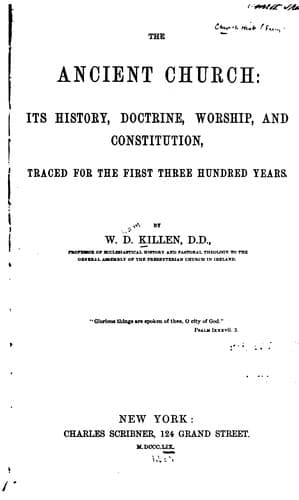
The Ancient Church: Its History, Doctrine, Worship, and ConstitutionKillen, W. D. (William Dool)
Religion
The Ancient Church: Its History, Doctrine, Worship, and Constitution
Killen, W. D. (William Dool)
Church history -- Primitive and early church, ca. 30-600
been proclaimed with some measure of encouragement in Caledonia.
Though no contemporary writer has furnished us with anything like an
ecclesiastical history of this period, it is very clear, from occasional
hints thrown out by the early apologists and controversialists, that the
progress of the Church must have been both extensive and rapid. A
Christian author, who flourished about the middle of the second century,
asserts that there was then "no race of men, whether of barbarians or of
Greeks, or bearing any other name, either because they lived in waggons
without fixed habitations, or in tents leading a pastoral life, among
whom prayers and thanksgivings were not offered up to the Father and
Maker of all things through the name of the crucified Jesus." [282:1]
Another father, who wrote shortly afterwards, observes that, "as in the
sea there are certain habitable and fertile islands, with wholesome
springs, provided with roadsteads and harbours, in which those who are
overtaken by tempests may find refuge--in like manner has God placed in
a world tossed by the billows and storms of sin, congregations or holy
churches, in which, as in insular harbours, the doctrines of truth are
sheltered, and to which those who desire to be saved, who love the
truth, and who wish to escape the judgment of God, may repair." [282:2]
These statements indicate that the gospel must soon have been very
widely disseminated. Within less than a hundred years after the
apostolic age places of Christian worship were to be seen in the chief
cities of the Empire; and early in the third century a decision of the
imperial tribunal awarded to the faithful in the great Western
metropolis a plot of ground for the erection of one of their religious
edifices. [282:3] At length about A.D. 260 the Emperor Gallienus issued
an edict of toleration in their favour; and, during the forty years
which followed, their numbers so increased that the ecclesiastical
buildings in which they had hitherto assembled were no longer sufficient
for their accommodation. New and spacious churches now supplanted the
old meeting-houses, and these more fashionable structures were soon
filled to overflowing. [282:4] But the spirit of the world now began to
be largely infused into the Christian communities; the Church was
distracted by its ministers struggling with each other for pre-eminence;
and even the terrible persecution of Diocletian which succeeded, could
neither quench the ambition, nor arrest the violence of contending
pastors.
Public-domain text, read in full here on John Shaqi.
Reviews
Reviews
No reviews yet
Be the first to share your thoughts on this work.
Elsewhere in the archive
Join the Discussion
Join the discussion
Sign in to leave a comment or review.
Sign InorCreate an account