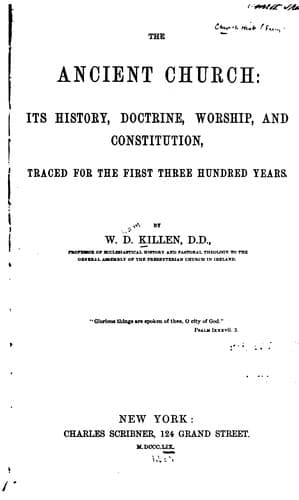
The Ancient Church: Its History, Doctrine, Worship, and ConstitutionKillen, W. D. (William Dool)
Religion
The Ancient Church: Its History, Doctrine, Worship, and Constitution
Killen, W. D. (William Dool)
Church history -- Primitive and early church, ca. 30-600
The study of the best forms of government was peculiarly congenial to
the Roman mind; and the peace enjoyed under the Empire, as contrasted
with the miseries of the civil wars in the last days of the Republic,
pleaded, no doubt, strongly in favour of a change in the ecclesiastical
constitution. But though this portion of the history of the Church is
involved in much obscurity, there are indications that the transference
of power from the presbyters to their president was not accomplished
without a struggle. Until this period the Roman elders appear to have
generally succeeded each other as moderators of presbytery in the order
of their seniority; [333:2] but it was now deemed necessary to adopt
another method of appointment; and it is not improbable that, at this
time, a division of sentiment as to the best mode of filling up the
presidential chair, was the cause of an unusually long vacancy.
According to some, no less than four years [333:3] passed away between
the death of Hyginus and the choice of his successor Pius; and even
those who object to this view of the chronology admit that there was an
interval of a twelvemonth. [333:4] The plan now adopted seems to have
been to choose the bishop by lot out of a leet of selected candidates.
[333:5] Thus, to use the phraseology current towards the end of the
second century, the new chief pastor "obtained _the lot_ of the
episcopacy." [334:1]
The changes introduced at Rome were probably far from agreeable to many
of the other Churches throughout the Empire; and Polycarp, the venerable
pastor of Smyrna, who was afterwards martyred, and who was now nearly
eighty years of age, appears to have been sent to the imperial city on a
mission of remonstrance. The design of this remarkable visit is still
enveloped in much mystery, for with the exception of an allusion to a
question confessedly of secondary consequence, [334:2] ecclesiastical
writers have passed over the whole subject in suspicious silence; but
there is every reason to believe that Polycarp was deputed to complain
of the incipient assumptions of Roman prelacy. [334:3] Anicetus, who
then presided over the Church of the capital, prudently bestowed very
flattering attentions on the good old Asiatic pastor; and, though there
is no evidence that his scruples were removed, he felt it to be his duty
to assist in opposing the corrupt teachers who were seeking to propagate
their errors among the Roman disciples. The testimony to primitive truth
delivered by so aged and eminent a minister produced a deep impression,
and gave a decided check to the progress of heresy in the metropolis of
the Empire. [334:4]
Public-domain text, read in full here on John Shaqi.
Reviews
Reviews
No reviews yet
Be the first to share your thoughts on this work.
Elsewhere in the archive
Join the Discussion
Join the discussion
Sign in to leave a comment or review.
Sign InorCreate an account