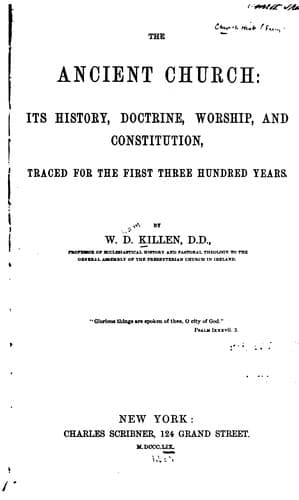
The Ancient Church: Its History, Doctrine, Worship, and ConstitutionKillen, W. D. (William Dool)
Religion
The Ancient Church: Its History, Doctrine, Worship, and Constitution
Killen, W. D. (William Dool)
Church history -- Primitive and early church, ca. 30-600
For the last forty years of the third century the Church was free from
persecution, and, during this long period of repose, the great Western
see enjoyed an unwonted measure of outward prosperity. Its religious
services were now conducted with increasing splendour, and distressed
brethren in very distant countries shared the fruits of its munificence.
In the reign of Gallienus, when the Goths burst into the Empire and
devastated Asia Minor, the bishop of Rome transmitted a large sum of
money for the release of the Christians who had fallen into the hands of
the barbarians. [359:3] A few years afterwards, when Paul of Samosata
was deposed for heresy, and when, on his refusal to surrender the
property of the Church of Antioch, an application was made to the
Emperor Aurelian for his interference, that prince submitted the matter
in dispute to the decision of Dionysius of Rome and the other bishops of
Italy. [360:1] This reference, in which the position of the Roman
prelate was publicly recognised, perhaps for the first time, by a Roman
Emperor, was calculated to add vastly to the importance of the
metropolitan see in public estimation. When Christianity was established
about fifty years afterwards by Constantine, the bishop of the chief
city was thus, to a great extent, prepared for the high position to
which he was suddenly promoted.
None of the early bishops of Rome were distinguished for their mental
accomplishments; and though they are commonly reputed the founders of
the Latin Church, it would appear that, for nearly two hundred years,
they all wrote and spoke the Greek language. The name _Pope_, which they
have since appropriated, was now common to all pastors. [360:2] For the
first three centuries almost every question relating to them is involved
in much mystery; and, as we approach the close of this period, the
difficulty of unravelling their perplexed traditions rather increases
than diminishes. Even the existence of some who are said to have now
flourished has been considered doubtful. [360:3] It is alleged that the
see was vacant for upwards of three years and a half during the
Diocletian persecution in the beginning of the fourth century; [360:4]
but even this point has not been very clearly ascertained. The Roman
bishopric was by far the most important in the Church; and the obscurity
which overhangs its early history, cannot but be embarrassing to those
who seek to establish a title to the ministry by attempting to trace it
up through such dark annals.
Public-domain text, read in full here on John Shaqi.
Reviews
Reviews
No reviews yet
Be the first to share your thoughts on this work.
Elsewhere in the archive
Join the Discussion
Join the discussion
Sign in to leave a comment or review.
Sign InorCreate an account