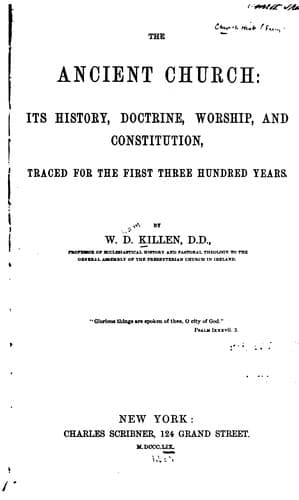
The Ancient Church: Its History, Doctrine, Worship, and ConstitutionKillen, W. D. (William Dool)
Religion
The Ancient Church: Its History, Doctrine, Worship, and Constitution
Killen, W. D. (William Dool)
Church history -- Primitive and early church, ca. 30-600
will build my Church, for Christ was the rock on whose foundation Peter
himself was built; for other foundation hath no man laid than that which
is laid, which is Christ Jesus." [362:3] In the Italian capital, the
words on which the power of the Papacy is understood to rest are
exhibited in gigantic letters within the dome of St Peter's; but their
exhibition only proves that the Church of Rome has lost the key of
knowledge; for, though she would fain appeal to Scripture, she shews
that she does not understand the meaning of its testimony; and, closing
her eyes against the light supplied by the best and wisest of the
fathers, she persists in adhering to a false interpretation.
SECTION II.
THE LITERATURE AND THEOLOGY OF THE CHURCH.
CHAPTER I.
THE ECCLESIASTICAL WRITERS.
By "the Fathers" we understand the writers of the ancient Christian
Church. The name is, however, of rather vague application, for though
generally employed to designate only the ecclesiastical authors of the
first six centuries, it is extended, occasionally, to distinguished
theologians who flourished in the middle ages.
The fathers of the second and third centuries have a strong claim on our
attention. Living on the verge of apostolic times, they were acquainted
with the state of the Church when it had recently passed from under the
care of its inspired founders; and, as witnesses to its early
traditions, their testimony is of peculiar value. But the period before
us produced comparatively few authors, and a considerable portion of its
literature has perished. There have been modern divines, such as Calvin
and Baxter, who have each left behind a more voluminous array of
publications than now survives from all the fathers of these two hundred
years. Origen was by far the most prolific of the writers who flourished
during this interval, but the greater number of his productions have
been lost; and yet those which remain, if translated into English, would
amount to nearly triple the bulk of our authorised version of the Bible.
His extant works are, however, more extensive than all the other
memorials of this most interesting section of the history of the Church.
Among the earliest ecclesiastical writers after the close of the first
century is Polycarp of Smyrna. He is said to have been a disciple of the
Apostle John, and hence he is known as one of the _Apostolic Fathers_.
[365:1] An epistle of his addressed to the Philippians, and designed to
correct certain vices and errors which had been making their appearance,
is still preserved. It seems to have been written towards the middle of
the second century; [365:2] its style is simple; and its general tone
worthy of a man who had enjoyed apostolic tuition. Its venerable author
suffered martyrdom about A.D. 167, [365:3] at the advanced age of
eighty-six. [365:4]
Public-domain text, read in full here on John Shaqi.
Reviews
Reviews
No reviews yet
Be the first to share your thoughts on this work.
Elsewhere in the archive
Join the Discussion
Join the discussion
Sign in to leave a comment or review.
Sign InorCreate an account