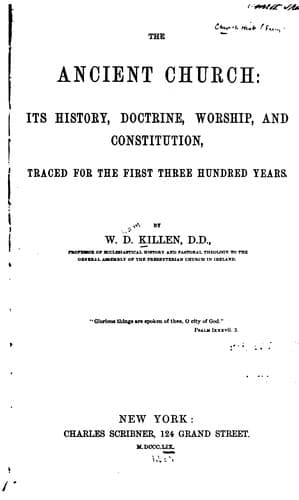
The Ancient Church: Its History, Doctrine, Worship, and ConstitutionKillen, W. D. (William Dool)
Religion
The Ancient Church: Its History, Doctrine, Worship, and Constitution
Killen, W. D. (William Dool)
Church history -- Primitive and early church, ca. 30-600
Attempts have been made to shew that two other writers, earlier than
Origen, have noticed the Ignatian correspondence; and Eusebius himself
has quoted Polycarp and Irenaeus as if bearing witness in its favour.
Polycarp in early life was contemporary with the pastor of Antioch; and
Irenaeus is said to have been the disciple of Polycarp; and, could it be
demonstrated that either of these fathers vouched for its genuineness,
the testimony would be of peculiar importance. But, when their evidence
is examined, it is found to be nothing to the purpose. In the Treatise
against Heresies, Irenaeus speaks, in the following terms, of the
heroism of a Christian martyr--"One of our people said, when condemned
to the beasts on account of his testimony towards God--As I am the wheat
of God, I am also ground by the teeth of beasts, that I may be found the
pure bread of God." [400:5] These words of the martyr are found in the
Syriac Epistle to the Romans, and hence it has been inferred that they
are a quotation from that letter. But it is far more probable that the
words of the letter were copied out of Irenaeus, and quietly
appropriated, by a forger, to the use of his Ignatius, with a view to
obtain credit for a false document. The individual who uttered them is
not named by the pastor of Lyons; and, after the death of that writer, a
fabricator might put them into the mouth of whomsoever he pleased
without any special danger of detection. The Treatise against Heresies
obtained extensive circulation; and as it animadverted on errors which
had been promulgated in Antioch, [401:1] it, no doubt, soon found its
way into the Syrian capital. [401:2] But who can believe that Irenaeus
describes Ignatius, when he speaks of "_one of our people_?" The martyr
was not such an insignificant personage that he could be thus ignored.
He was one of the most eminent Christians of his age--the companion of
apostles--and the presiding minister of one of the most influential
Churches in the world. Irenaeus is obviously alluding to some disciple
who occupied a very different position. He is speaking, not of what the
martyr _wrote_, but of what he _said_--not of his letters, but of his
words. Any reader who considers the situation of Irenaeus a few years
before he published this treatise, can have no difficulty in
understanding the reference. He had witnessed at Lyons one of the most
terrible persecutions the disciples ever had endured; and, in the letter
to the Churches of Asia and Phrygia, he had graphically described its
horrors. [401:3] He there tells how his brethren had been condemned to
be thrown to wild beasts, and he records with simplicity and pathos the
constancy with which they suffered. But in such an epistle he could not
notice every case which had come under his observation, and he here
mentions a new instance of the Christian courage of some believer
unknown to fame, when he states--"one of our people when condemned to
Public-domain text, read in full here on John Shaqi.
Reviews
Reviews
No reviews yet
Be the first to share your thoughts on this work.
Elsewhere in the archive
Join the Discussion
Join the discussion
Sign in to leave a comment or review.
Sign InorCreate an account