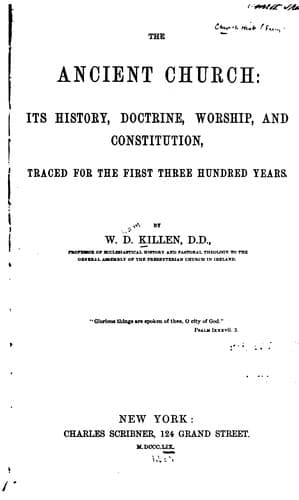
The Ancient Church: Its History, Doctrine, Worship, and ConstitutionKillen, W. D. (William Dool)
Religion
The Ancient Church: Its History, Doctrine, Worship, and Constitution
Killen, W. D. (William Dool)
Church history -- Primitive and early church, ca. 30-600
It appears, then, that this testimony of the pastor of Smyrna has been
strangely misunderstood. Ignatius, as is well known, was not a very
uncommon name; and it would seem that several martyrs of the ancient
Church bore this designation. Cyprian, for example, tells us of an
Ignatius in Africa who was put to death for the profession of
Christianity in the former part of the third century. [405:1] It is
apparent from the words of Polycarp that there was also an Ignatius of
Philippi, as well as an Ignatius of Antioch.
It may, however, be objected that the conclusion of this letter clearly
points to Ignatius of Antioch, inasmuch as Polycarp there speaks
apparently of _Syria_, and of some one interested about Ignatius who
might shortly visit that country. [405:2] Some critics of high name have
maintained that this portion of the epistle is destitute of authority,
and that it has been added by a later hand to countenance the Ignatian
forgery. [405:3] But every candid and discriminating reader may see that
the charge is destitute of foundation. An Ignatian interpolator would
not have so mismanaged his business. He would not have framed an
appendix which, as we shall presently shew, testifies against himself.
The passage to which such exception has been taken is unquestionably the
true postscript of the letter, for it bears internal marks of
genuineness.
In this postscript Polycarp says--"What you know certainly both of
Ignatius himself, and of those _who are with him_, communicate." [405:4]
Here is another proof that the Ignatius of Polycarp is not Ignatius of
Antioch. The Syrian pastor is said to have been hurried with the utmost
expedition to Rome that he might be thrown to the beasts before the
approaching termination of the public spectacles; and it is reported
that when he reached the great city, he was forthwith consigned to
martyrdom. [406:1] But, though letters had been meanwhile passing
between Philippi and Smyrna, this Ignatius is understood to be still
alive. It would appear, too, that Zosimus and Rufus, previously named as
his partners in tribulation, continued to be his companions. Polycarp,
therefore, must be speaking of the "patience" of confessors who were yet
"in bonds," [406:2] and not of a man who had already been devoured by
the lions.
Public-domain text, read in full here on John Shaqi.
Reviews
Reviews
No reviews yet
Be the first to share your thoughts on this work.
Elsewhere in the archive
Join the Discussion
Join the discussion
Sign in to leave a comment or review.
Sign InorCreate an account