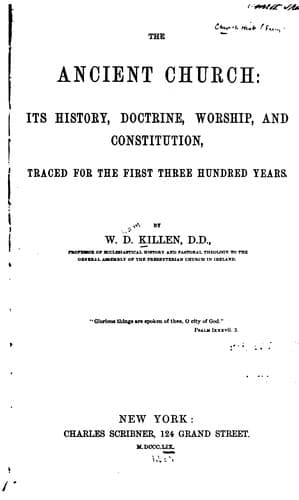
The Ancient Church: Its History, Doctrine, Worship, and ConstitutionKillen, W. D. (William Dool)
Religion
The Ancient Church: Its History, Doctrine, Worship, and Constitution
Killen, W. D. (William Dool)
Church history -- Primitive and early church, ca. 30-600
The history of the Ignatian Epistles may well remind us of the story of
the Sibylline Books. A female in strange attire is said to have appeared
before Tarquin of Rome, offering to sell nine manuscripts which she had
in her possession; but the king, discouraged by the price, declined the
application. The woman withdrew; destroyed the one-third of her literary
treasures; and, returning again into the royal presence, demanded the
same price for what were left. The monarch once more refused to come up
to her terms; and the mysterious visitor retired again, and burnt the
one-half of her remaining store. Her extraordinary conduct excited much
astonishment; and, on consulting with his augurs, Tarquin was informed
that the documents which she had at her disposal were most valuable, and
that he should by all means endeavour to secure such a prize. The king
now willingly paid for the three books, not yet committed to the flames,
the full price originally demanded for all the manuscripts. The Ignatian
Epistles have experienced something like the fate of those Sibylline
oracles. In the sixteenth century, fifteen letters were brought out from
beneath the mantle of a hoary antiquity, and offered to the world as the
productions of the pastor of Antioch. Scholars refused to receive them
on the terms required, and forthwith eight of them were admitted to be
forgeries. In the seventeenth century, the seven remaining letters, in a
somewhat altered form, again came forth from obscurity, and claimed to
be the works of Ignatius. Again, discerning critics refused to
acknowledge their pretensions; but curiosity was roused by this second
apparition, and many expressed an earnest desire to obtain a sight of
the real epistles. Greece, Syria, Palestine, and Egypt were ransacked in
search of them, and at length three letters are found. The discovery
creates general gratulation; it is confessed that four of the Epistles,
so lately asserted to be genuine, are apocryphal; and it is boldly said
that the three now forthcoming are above challenge. [414:1] But Truth
still refuses to be compromised, and sternly disowns these claimants for
her approbation. The internal evidence of these three epistles
abundantly attests that, like the last three books of the Sibyl, they
are only the last shifts of a grave imposture. [414:2]
The candid investigator, who compares the Curetonian version of the
letters with that previously in circulation, must acknowledge that
Ignatius, in his new dress, has lost nothing of his absurdity and
extravagance. The passages of the Epistles, which were formerly felt to
be so objectionable, are yet to be found here in all their unmitigated
folly. Ignatius is still the same anti-evangelical formalist, the same
puerile boaster, the same dreaming mystic, and the same crazy fanatic.
These are weighty charges, and yet they can be substantiated. But we
must enter into details, that we may fairly exhibit the spirit, and
expose the falsehood of these letters.
Public-domain text, read in full here on John Shaqi.
Reviews
Reviews
No reviews yet
Be the first to share your thoughts on this work.
Elsewhere in the archive
Join the Discussion
Join the discussion
Sign in to leave a comment or review.
Sign InorCreate an account