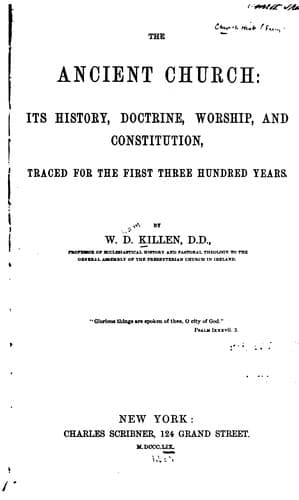
The Ancient Church: Its History, Doctrine, Worship, and ConstitutionKillen, W. D. (William Dool)
Religion
The Ancient Church: Its History, Doctrine, Worship, and Constitution
Killen, W. D. (William Dool)
Church history -- Primitive and early church, ca. 30-600
It is very clear that our Lord committed, in the first instance, to the
Twelve the organisation of the ecclesiastical commonwealth. The most
ancient Christian Church, that of the metropolis of Palestine, was
modelled under their superintendence; and the earliest converts gathered
into it, after His ascension, were the fruits of their ministry. Hence,
in the Apocalypse, the wall of the "holy Jerusalem" is said to have
"twelve foundations, and in them the names of the twelve apostles of the
Lamb." [46:1] But it does not follow that others had no share in
founding the spiritual structure. The Seventy also received a commission
from Christ, and we have every reason to believe that, after the death
of their Master, they pursued their missionary labours with renovated
ardour. That they were called apostles as well as the Twelve, cannot,
perhaps, be established by distinct testimony; [46:2] but it is certain,
that they were furnished with supernatural endowments; [46:3] and it is
scarcely probable that they are overlooked in the description of the
sacred writer when He represents the New Testament Church as "built upon
the foundation of the _apostles and prophets_, Jesus Christ himself
being the chief corner stone." [46:4]
The appointment of the Seventy, like that of the Twelve, was a typical
act; and it is not, therefore, extraordinary that they are only once
noticed in the sacred volume. Our Lord never intended to constitute two
permanent corporations, limited, respectively, to twelve and seventy
members, and empowered to transmit their authority to successors from
generation to generation. In a short time after His death the symbolical
meaning of the mission of the Seventy was explained, as it very soon
appeared that the gospel was to be transmitted to all the ends of the
earth; and thus it was no longer necessary to refer to these
representatives of the ministry of the universal Church. When the Twelve
turned to the Gentiles, their number lost its significance, and from
that date they accordingly ceased to fill up vacancies occurring in
their society; and, as the Church assumed a settled form, the apostles
were disposed to insist less and less on any special powers with which
they had been originally furnished, and rather to place themselves on a
level with the ordinary rulers of the ecclesiastical community. Hence we
find them sitting in church courts with these brethren, [47:1] and
desirous to be known not as apostles, but as elders. [47:2] We possess
little information respecting either their official or their personal
history. A very equivocal, and sometimes contradictory, tradition [47:3]
is the only guide which even professes to point out to us where the
greater number of them laboured; and the same witness is the only
voucher for the statements which describe how most of them finished
their career. It is an instructive fact that no proof can be given, from
the sacred record, of the ordination either by the Twelve or by the
Public-domain text, read in full here on John Shaqi.
Reviews
Reviews
No reviews yet
Be the first to share your thoughts on this work.
Join the Discussion
Join the discussion
Sign in to leave a comment or review.
Sign InorCreate an account