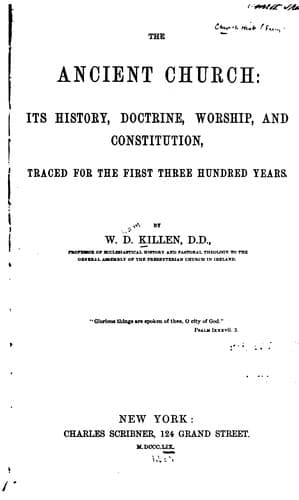
The Ancient Church: Its History, Doctrine, Worship, and ConstitutionKillen, W. D. (William Dool)
Religion
The Ancient Church: Its History, Doctrine, Worship, and Constitution
Killen, W. D. (William Dool)
Church history -- Primitive and early church, ca. 30-600
It was not, however, very obvious, from any of the cases already
enumerated, that the salvation of Christ was designed for all classes
and conditions of the human family. The Samaritans did not, indeed,
worship at Jerusalem, but they claimed some interest in "the promises
made unto the fathers;" and they conformed to many of the rites of
Judaism. It does not appear that the Ethiopian eunuch was of the seed of
Abraham; but he acknowledged the inspiration of the Old Testament, and
he was disposed, at least to a certain extent, to observe its
institutions. Even the Roman centurion was what has been called a
_proselyte of the gate_, that is, he professed the Jewish theology--"he
feared God with all his house" [58:1]--though he had not received
circumcision, and had not been admitted into the congregation of Israel.
But the time was approaching when the Church was to burst forth beyond
the barriers within which it had been hitherto inclosed, and an
individual now appeared upon the scene who was to be the leader of this
new movement. He is "a citizen of no mean city" [58:2]--a native of
Tarsus in Cilicia, a place famous for its educational institutes
[58:3]--and he is known, by way of distinction, as "an apostle of _the
nations_." [58:4]
The apostles were at first sent only to their own countrymen; [58:5] and
we have seen that, for some time after our Lord's death, they do not
appear to have contemplated any more comprehensive mission. When Peter
called on the disciples to appoint a successor to Judas, he seems to
have acted under the conviction that the company of the Twelve must
still be maintained in its integrity, and that its numbers must still
exactly correspond to the number of the tribes of Israel. But the Jews,
after the death of Stephen, evinced an increasing aversion to the
gospel; and as the apostles were eventually induced to direct their
views elsewhere, they were, of course, also led to abandon an
arrangement which had a special reference to the sectional divisions of
the chosen people. Meanwhile, too, the management of ecclesiastical
affairs had partially fallen into other hands; new missions, in which
the Twelve had no share, had been undertaken; and Paul henceforth
becomes most conspicuous and successful in extending and organising the
Church.
Public-domain text, read in full here on John Shaqi.
Reviews
Reviews
No reviews yet
Be the first to share your thoughts on this work.
Join the Discussion
Join the discussion
Sign in to leave a comment or review.
Sign InorCreate an account