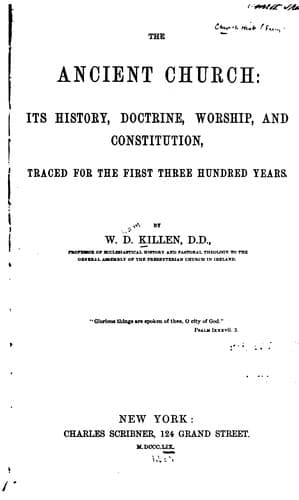
The Ancient Church: Its History, Doctrine, Worship, and ConstitutionKillen, W. D. (William Dool)
Religion
The Ancient Church: Its History, Doctrine, Worship, and Constitution
Killen, W. D. (William Dool)
Church history -- Primitive and early church, ca. 30-600
Paul describes himself as "one born out of due time." [59:1] He was
converted to Christianity when his countrymen seemed about to be
consigned to judicial blindness; and he was "called to be an apostle"
[59:2] when others had been labouring for years in the same vocation.
But he possessed peculiar qualifications for the office. He was ardent,
energetic, and conscientious, as well as acute and eloquent. In his
native city Tarsus he had probably received a good elementary education,
and afterwards, "at the feet of Gamaliel," [59:3] in Jerusalem, he
enjoyed the tuition of a Rabbi of unrivalled celebrity. The apostle of
the Gentiles had much the same religious experience as the father of the
German Reformation; for as Luther, before he understood the doctrine of
a free salvation, attempted to earn a title to heaven by the austerities
of monastic discipline, so Paul in early life was "taught according to
the perfect manner of the law of the fathers," [59:4] and "after the
strictest sect of his religion lived a Pharisee." [59:5] His zeal led
him to become a persecutor; and when Stephen was stoned, the witnesses,
who were required to take part in the execution, prepared themselves for
the work of death, by laying down their upper garments at the feet of
the "young man" Saul. [59:6] He had established himself in the
confidence of the Sanhedrim, and he appears to have been a member of
that influential judicatory, for he tells us that he "shut up many of
the saints in prison," and that, when they were put to death, "he gave
his voice, or his _vote_, [60:1] against them"--a statement implying
that he belonged to the court which pronounced the sentence of
condemnation. As he was travelling to Damascus armed with authority to
seize any of the disciples whom he discovered in that city, and to
convey them bound to Jerusalem, [60:2] the Lord appeared to him in the
way, and he was suddenly converted. [60:3] After reaching the end of his
journey, and boldly proclaiming his attachment to the party he had been
so recently endeavouring to exterminate, he retired into Arabia, [60:4]
where he appears to have spent three years in the devout study of the
Christian theology. He then returned to Damascus, and entered, about
A.D. 37, [60:5] on those missionary labours which he prosecuted with so
much efficiency and perseverance for upwards of a quarter of a century.
Public-domain text, read in full here on John Shaqi.
Reviews
Reviews
No reviews yet
Be the first to share your thoughts on this work.
Join the Discussion
Join the discussion
Sign in to leave a comment or review.
Sign InorCreate an account