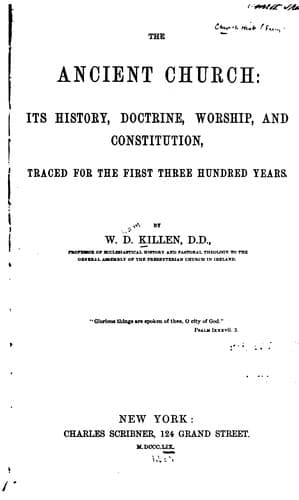
The Ancient Church: Its History, Doctrine, Worship, and ConstitutionKillen, W. D. (William Dool)
Religion
The Ancient Church: Its History, Doctrine, Worship, and Constitution
Killen, W. D. (William Dool)
Church history -- Primitive and early church, ca. 30-600
voice to call them _Christians_. The inventor of the title may have
meant it as a nickname, but if so, He who overruled the waywardness of
Pilate so that he wrote on the cross a faithful inscription, [65:1] also
caused this mocker of His servants to stumble on a most truthful and
complimentary designation.
From his first appearance in Antioch Paul seems to have occupied a very
influential position among his brethren. In that refined and opulent
city his learning, his dialectic skill, his prudence, and his pious
ardour were all calculated to make his ministry most effective. About a
year after his arrival there, he was deputed, in company with a friend,
to visit Palestine on an errand of love. "In those days came prophets
from Jerusalem unto Antioch. And there stood up one of them, named
Agabus, and signified by the Spirit that there should be great dearth
throughout all the world; which came to pass in the days of Claudius
Caesar. Then the disciples, every man according to his ability,
determined to send relief to the brethren which dwelt in Judea. Which
also they did, and sent it to the elders by the hands of Barnabas and
Saul." [65:2]
This narrative attests that the principle of a community of goods was
not recognised in the Church of Antioch, for the aid administered was
supplied, not out of a general fund, but by "every man according to his
ability." There was here no "murmuring of the Grecians against the
Hebrews," as, in the spirit of true brotherhood, the wealthy Hellenists
of Antioch cheerfully contributed to the relief of the poor Hebrews of
their fatherland. It does not appear that "the elders" in whose hands
the money was deposited, were all office-bearers connected with the
Church of Jerusalem. These would, of course, receive no small share of
the donations, but as the assistance was designed for the "brethren
which dwelt _in Judea_," and not merely for the disciples in the holy
city, we may infer that it was distributed among the elders of all the
Churches now scattered over the southern part of Palestine. [66:1]
Neither would Barnabas and Paul require to make a tour throughout the
district to visit these various communities. All the elders of Judea
still continued to observe the Mosaic law, and as the deputies from
Antioch were in Jerusalem at the time of the Passover, [66:2] they would
find their brethren in attendance upon the festival.
Public-domain text, read in full here on John Shaqi.
Reviews
Reviews
No reviews yet
Be the first to share your thoughts on this work.
Elsewhere in the archive
Join the Discussion
Join the discussion
Sign in to leave a comment or review.
Sign InorCreate an account